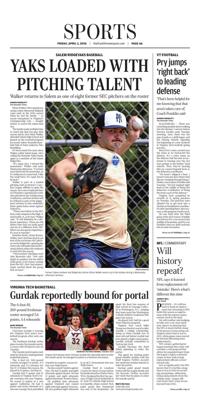


Former Salem resident and RidgeYaks pitcher Ethan Walker warms up in the bullpen during a Wednesday afternoon workout.
Former Salem resident and RidgeYaks pitcher Ethan Walker warms up in the bullpen during a Wednesday afternoon workout.
Former Salem resident and RidgeYaks pitcher Ethan Walker warms up in the bullpen during a Wednesday afternoon workout.
Former Salem resident and RidgeYaks pitcher Ethan Walker warms up in the bullpen during a Wednesday afternoon workout.
SMLA volunteer Michael Rodgers describes how the Smith Mountain Dam works to Liberty High School students at Smith Mountain Lake State Park on Wednesday as part of their Lake Days program.
HUDDLESTON — Bedford County students got the opportunity to see some environmental science outside the classroom this week with a program focused on Smith Mountain Lake.
Students from each of the county's three high schools spent a day at Smith Mountain Lake State Park earlier this week getting a hands-on understanding of the man-made lake and the complex ecosystem around it. They were able to use science equipment in the lake and even in one of its tributaries at the park.
The program is done through collaboration between Bedford County Public Schools and the Smith Mountain Lake Association, with some assistance from the Bedford Regional Water Authority that provided some volunteers and demonstrations for students throughout the day. Known as Lake Days, it provides students with a chance to see science in the real world instead of in the classroom.
"It is basically supplementing what they are learning in the classroom," said Tye Campbell, a SMLA volunteer and organizer. "We are trying to create a spark in them."
Connie Hylton, a SMLA volunteer, helps Liberty High School students sort through the dirt, debris and macroinvertebrates collected in Buck Run at Smith Mountain Lake State Park.
That spark the SMLA is looking for is a love and interest in Smith Mountain Lake and the environment. Campbell said the SMLA wants the next generation to better understand and appreciate the lake.
Now in its second year, the program seems to be working. Allison Kappler, Bedford County Public Schools' supervisor of science and computer science, said Lake Days has been a positive program for giving ninth graders some hands-on experience.
Kappler reached out to the SMLA last year about starting the Lake Days program as a no-cost way of getting students closer experiences in environmental science with no cost to the school. The SMLA is an all-volunteer organization with several members who have a deep understanding and strong passion for the lake they enjoy sharing with students.
More than 200 Bedford County ninth graders moved around in small groups to five stations set up inside the park's Discovery Center, on some nearby docks and at the Buck Run stream along one of the park's many trails. The stations provided insight into how Smith Mountain Dam works, how to test its water quality and its overall health.
"Anything we can do to hook a kid and get them interested in science is a win," said Keri Green, an SMLA volunteer. She provided each student with Foldscope microscopes and gave them the opportunity to look at slides of insect legs and mold cells.
Outside, SMLA volunteer Tom Burns hooked up a water hose to a turbine that created electricity for a string of lights. He said the students would light up when they started to better understand how the dam generates electricity.
"A lot of this is a revelation to them," Burns said.
Some of the biggest revelations came when students placed nets into the Buck Run stream to catch a variety of macroinvertebrates as well as whatever else decided to crawl in. Students were apprehensive at first, but they eventually warmed up to the idea of picking up and counting bugs.
Geoff Orth, a SMLA volunteer who oversees its stream monitoring program, manned the station along with several other volunteers during the week. He explained to students what each of the bugs were and how they helped to understand how clean the tributary is.
Students counted each of the creatures collected to provide an overall score for the stream's health. If more pollution-intolerant macroinvertebrates were seen, the score was higher. Orth said scores for streams are scored from 0 to 12, adding that the Buck Run stream usually scores around a 9.
Once the net was out of the water, it was placed on a nearby table set up beside the stream, and students started their count. Using tweezers, they would sort through the debris of leaves and dirt to find the creatures and collect them to get a count.
Orth said his station and others set up throughout the day provides students with the opportunity to use the scientific method out in nature. Whether they know it or not, they are putting science in action and getting a better understanding of Smith Mountain Lake and the world around them.
Jason Dunovant (540) 981-3324
Martinsville City Council met for a special-called meeting in Council Chambers on Monday.
The Martinsville City Council took its latest step Monday toward making public at least part of the long-running investigation that began with the firing in August of former City Manager Aretha Ferrell-Benavides.
The council’s special-called closed session meeting began at 5:30 p.m. Monday, and later that evening, the council voted 5-0 to move toward releasing information from the forensic audit.
The council went behind closed doors for about 90 minutes to discuss employment-law litigation and questions involving investigative reports and attorney-client privilege, then returned and directed the city attorney and city manager to prepare a forensic-audit report for the council to consider for release at its next meeting.
The council also agreed to add another closed session to continue discussing the workplace investigation.
That vote is the newest turn in a controversy that has hung over Martinsville for months, divided council members, strained public trust, and cost the city heavily in legal and investigative fees.
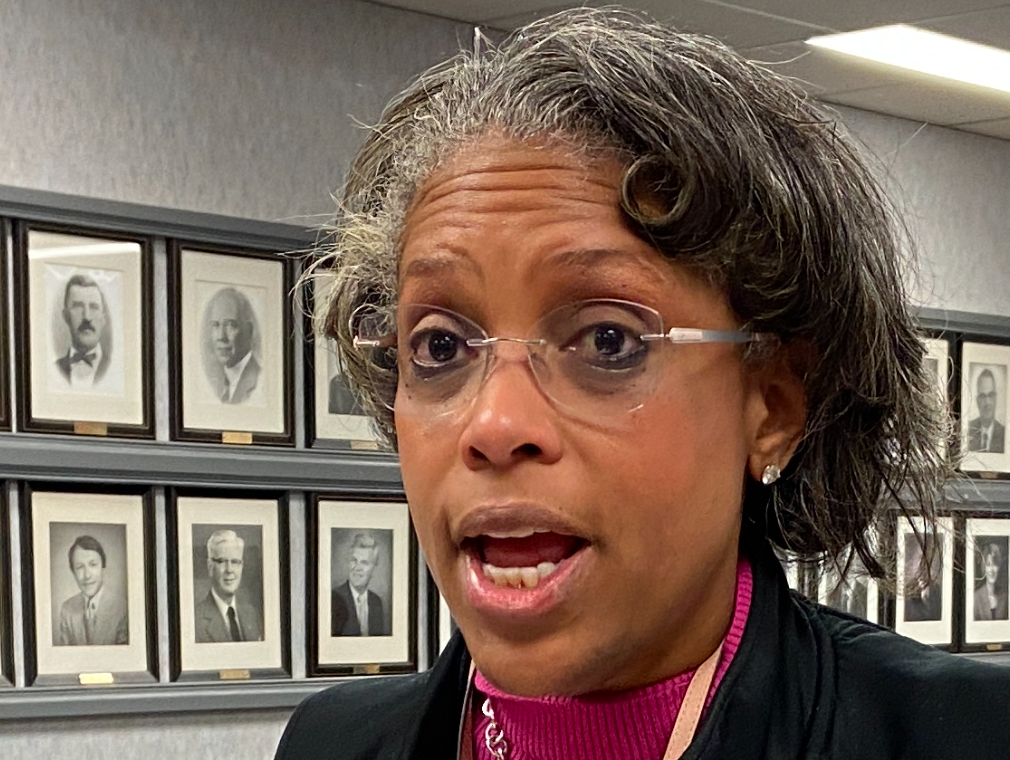
Ferrell-Benavides
The matter began publicly last spring, when questions surfaced about city spending on credit cards, including travel, meals, and a nearly $2,000 golf outing. Ferrell-Benavides defended those expenses at the time as training and team-building costs, but the criticism escalated. In July, the council placed her on administrative leave and approved $20,000 for a forensic audit.
The controversy widened beyond travel spending, tied to the a whistleblower’s concerns about city finances, including American Rescue Plan Act funds, while council critics continued to cite card charges for dinners, hotels, and trips as evidence that closer scrutiny was needed.
On Aug. 7, after a closed session, the council voted 4-1 to fire Ferrell-Benavides for cause. City officials said the reasons included malfeasance and dishonesty, violations of the city charter, city code, city policy, rules and regulations, and unsatisfactory performance. Mayor L.C. Jones cast the lone dissenting vote.
The legal backbone of that firing was an investigative report prepared by Sands Anderson, the Richmond-based law firm serving as Martinsville’s outside counsel. But that report quickly became almost as controversial as the firing itself.
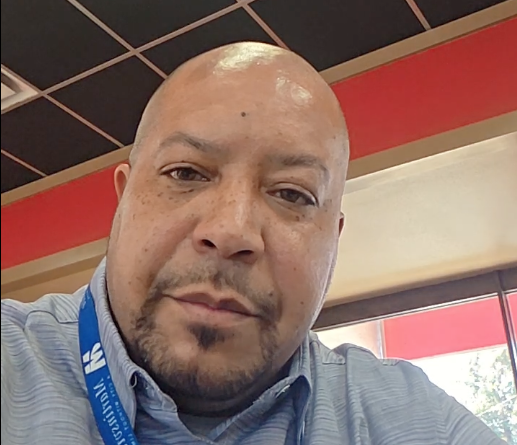
Jones
Later in August, a split council refused to release the findings publicly, with members citing attorney-client privilege. Jones abstained, and Sands Anderson advised against release. Months later, a version of the report released in response to a records request was so heavily redacted that it revealed almost nothing substantive, deepening public frustration rather than resolving it.
The separate forensic audit was conducted by Brown Edwards, an accounting firm hired for $20,000. That audit was not declared complete until late December. By then, the investigation’s financial toll had become a story of its own.
Jones said in December that, when combined with Sands Anderson’s work, the city’s costs had already topped $400,000 — far beyond Martinsville’s annual legal budget of $250,000.
Even after the audit was finished, the city did not move quickly to put it before the public. Council members first reviewed it in closed session Jan. 8. The following day, the council voted 4-0, with Jones abstaining, to release whatever information from the forensic audit and the Sands Anderson workplace investigation could be made public without interfering with a criminal inquiry.
The council also directed that the full forensic audit findings be shared with the Virginia State Police and special prosecutor Wes Nance.
Flinn
That criminal-investigation track has since become more complicated. Martinsville Commonwealth’s Attorney Patrick Flinn said recently that Nance, the Bedford County prosecutor appointed as special prosecutor, moved to withdraw after taking the bench as a judge.
Flinn then sought to have Attorney General Jay Jones take over, but the attorney general’s office said the request had not gone through the governor’s office and therefore could not be acted on under the proper procedure.
Flinn says he is now seeking a replacement for Nance.
Meanwhile, the city has been trying to stabilize its own operations. Robert Fincher, who had been serving as interim city manager since August, was formally appointed city manager on March 11. And last week, Fincher said Martinsville would eliminate city employee charge cards and move to a new expensing system.
What Monday’s action means is that Martinsville may finally be approaching the point the public has demanded for months: some accounting of what happened, who did what, and what the city plans to do next.
But the council’s wording matters.
It did not vote on Monday to release the full audit outright. It voted to have city officials prepare the report for the council to consider releasing at the next meeting, now scheduled for April 14. That leaves open the possibility of a summary, a redacted version, or some other limited disclosure rather than a full public airing.
With its critics and supporters, the issue has become a test of whether Martinsville’s government can credibly investigate itself, explain how public money was spent, and restore trust after months of closed sessions, redactions, and political infighting.
If the city releases meaningful findings, residents may finally get a clearer picture of whether the controversy involved criminal conduct, reckless management, internal dysfunction, or some combination of all three.
If the release is narrow or delayed again, the audit saga is likely to remain what it has been for much of the past year: a costly document that has produced more suspicion than closure.
A federal judge declined Monday to dismiss a lawsuit that accuses a Virginia state trooper of chasing a motorist who was rushing his critically ill daughter to a Salem hospital, drawing his gun on the man in the parking lot, and delaying medical treatment for the 10-year-old girl.
The alleged conduct by Trooper Timothy Derosha “shocks the conscience,” U.S. District Judge Elizabeth Dillon wrote in an opinion.
The lawsuit makes the following claims:
On Dec. 6, 2022, Michael Morris of Franklin County was advised by his family physician to immediately drive his daughter to LewisGale Medical Center for treatment of her worsening illness, which was later determined to be pneumonia.
When the girl began to have difficulty breathing, Morris accelerated to about 65 mph in a 45-mph zone, turned his four-way flashers on, and drove through several red lights after checking to be sure there were no cars in the intersections.
About two miles from the hospital, Derosha began to pursue Morris on Electric Road. At that point, Morris called 911 and told the dispatcher that he had a medical emergency and a state trooper was trying to pull him over.
After following the car into the emergency room parking lot, Derosha jumped out of his police cruiser, drew his handgun, and told Morris: “I’m going to kill you if you move again,” the lawsuit alleges.
The trooper then ordered Morris to his knees and issued a series of demands while placing him in handcuffs — preventing the 10-year-old from reaching the emergency room for about two and a half minutes.
Such a delay under the circumstances does not shock the conscience, an assistant attorney general argued in a motion to dismiss the lawsuit, which was filed on behalf of the minor by her parents.
Dillon disagreed. “It is obvious that when someone cannot breathe, they require immediate medical care,” her opinion stated. “In that type of medical emergency, seconds matter.”
Eventually, the trooper allowed Morris’ wife to take their daughter into the hospital. The girl was later transported by ambulance to a children’s hospital in Richmond, where she remained for several days.
Attorneys for Derosha also contended that he was acting in a tense situation with little time to evaluate the circumstances — an argument that was opposed by the 10-year-old’s attorney, Jennifer French.
“If it was a hyper-pressurized environment, it was only because of Derosha’s unreasonable escalation,” French wrote in court papers.
Derosha faces a second lawsuit from Michael Morris and a third involving a different situation.
In May 2024, David Tate claims in his lawsuit, Derosha followed him home and detained him briefly after he raised his middle finger at the trooper when they met by chance at a Salem intersection.
The rude gesture was an act of criticism toward law enforcement and protected by his First Amendment right to free expression, Tate argues.
In that case, Dillon ruled that Tate’s brief encounter with Derosha did not amount to an unlawful seizure when he was questioned about a warrant that didn’t exist. “A personal seizure usually comes with at least some interrogation, pat-down, express restraint, isolation, securing of the scene, seeking of consent, physical search or charges,” Dillon wrote, noting that none of that happened.
A second count in the lawsuit — that Derosha retaliated against Tate for exercising his First Amendment rights — is scheduled for a trial in December.
Laurence Hammack (540) 981-3239
Carter Bank & Trust at 4 Commonwealth Blvd. in Martinsville.
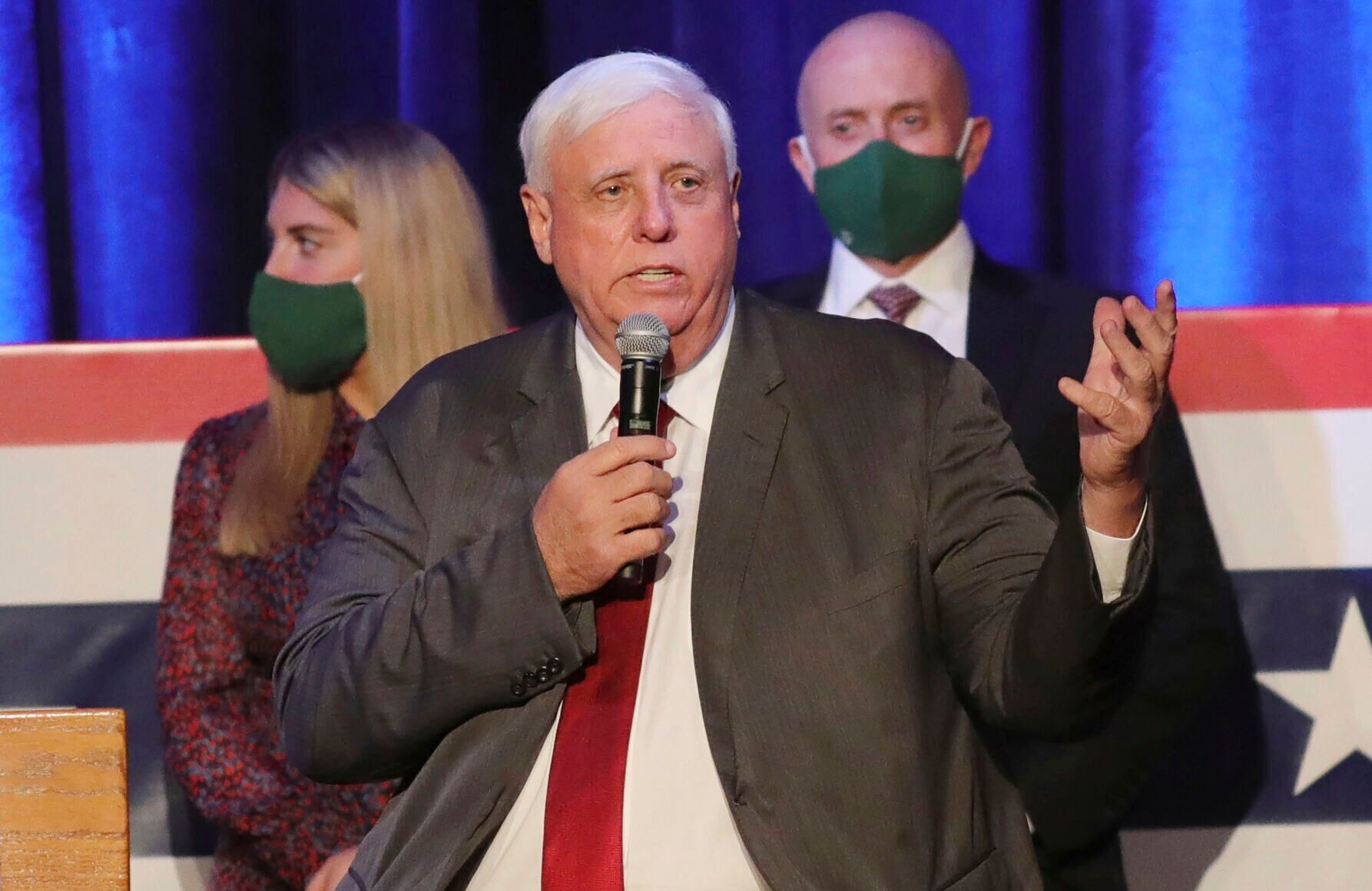
Former West Virginia Gov. Jim Justice ran for U.S. Senate and was elected, even as controversy and legal troubles swirled around his finances.
MARTINSVILLE — Carter Bankshares Inc. has completed the sale of a large portfolio of nonperforming loans tied to businesses controlled by U.S. Sen. Jim Justice and his family, according to a filing with the U.S. Securities and Exchange Commission.
The Martinsville-based bank with locations in Lynchburg disclosed in a Form 8-K that it sold the loans on March 26 to an unaffiliated third party in an “as-is, where-is” transaction. The buyer was not identified.
The bank received $289.48 million in cash for the loans, which had an outstanding principal balance of $209.48 million at the time of the sale. The loans had been classified as nonperforming and placed on nonaccrual status, meaning they were no longer generating interest income.
The portfolio stems from lending relationships with companies connected to Justice — a Republican senator from West Virginia and former governor — as well as his wife, Cathy Justice, and their son, Jay Justice. The loans were personally guaranteed by members of the Justice family.
Carter Bank had previously identified the Justice-related loans as a significant concentration of credit risk. In recent years, the relationship between the bank and the Justice family’s business empire — which includes coal, agriculture, and hospitality operations across Virginia, West Virginia, and North Carolina — has drawn attention due to repayment disputes and legal action.
At one point, Justice-affiliated companies owed Carter Bank as much as $775 million. That figure had been reduced to roughly $300 million by early 2023, when the bank initiated legal proceedings to recover outstanding debt.
The Justices, in turn, accused the bank of interfering with their ability to refinance the loans with other lenders and violating banking laws. Carter Bank denied those claims, saying it had worked with the borrowers over an extended period and that repayment efforts had stalled.
The dispute was resolved in mid-2023, when both sides announced a settlement agreement outlining repayment terms. Despite that agreement, the loans remained troubled and were placed on nonaccrual status in 2023, cutting off a significant stream of expected interest income for the bank.
In its most recent annual disclosures, Carter Bank reported that it had forgone tens of millions of dollars in interest due to the nonaccrual designation of the loans.
The sale marks a major step in removing those assets from the bank’s balance sheet.
According to the SEC filing, the transaction would have significantly reduced the bank’s nonperforming loan level if completed at the end of 2025. Pro forma figures included in the filing show nonperforming loans dropping from about $243.98 million, or 6.29% of total loans, to approximately $29.96 million, or 0.82% of total loans.
Total loans would have declined from $3.88 billion to $3.67 billion, while total assets would have increased to about $4.95 billion. The bank also reported that its allowance for credit losses would have decreased as a percentage of total loans.
Carter Bank said it expects the transaction to improve its tangible book value per share by approximately $3.49. Tangible book value is a key financial metric used by investors to assess a bank’s underlying asset strength.
The company said additional details about the financial impact of the sale will be included in its first-quarter earnings report and quarterly filing for the period ending March 31.
The Justice family’s business operations have faced broader financial pressures in recent years, including multiple lawsuits, unpaid vendor claims, and tax-related disputes tied to coal operations and other holdings. Those issues have contributed to scrutiny of the family’s debt obligations and lending relationships.
Carter Bank, which has approximately $5 billion in assets and operates more than 60 branches across Virginia and North Carolina, had previously cited the Justice-related loans as among its largest and most complex credit exposures.
By selling the loans outright, the bank appears to reduce risk tied to a single borrower and strengthen its balance sheet by eliminating a large block of troubled assets.
Neither Carter Bank nor representatives for the Justice family have publicly identified the purchaser of the loan portfolio.