
Community meeting on 1% sales tax set for Monday
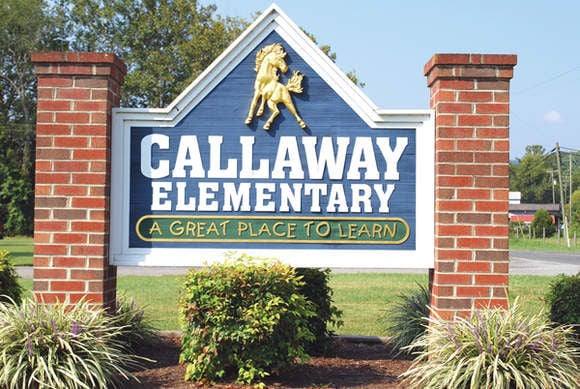
Callaway Elementary School is one of several Franklin County Public Schools in need of substantial repairs. County voters will consider adding a 1% sales tax to pay for school capital needs in the November election.
Franklin County Public Schools is holding the last of a series of community meetings Monday to continue garnering support for the 1% sales tax referendum that is on the November ballot.
The final community meeting before the election will be at 6 p.m. Monday at Rocky Mount Elementary School. Members of Franklin County Public Schools and other county staff will attend to answer questions.
Franklin County is one of multiple localities adding the referendum to the ballot this November. Virginia legislators approved and Gov. Abigail Spanberger signed a budget bill earlier this year that included giving localities the authority to use a 1% sales tax to address school infrastructure needs.
"We've had three of the town hall meetings so far and we've had a number of smaller meetings where we have been invited to meet with groups or with PTOs at all our elementary schools," said Franklin County Public Schools Superintendent Kevin Siers.
Those school infrastructure needs are hitting a critical point in Franklin County. Siers said the school district has $102 million in capital needs at its schools with many being critical. Those projects include roof repairs or putting in new HVAC systems.
Franklin County is currently only able to budget $1 million to address those capital needs. Siers said much more is needed.
"If nothing else breaks, it would take us 102 years to pay off everything that we've currently identified as needing to be addressed," Siers said.
With no additional funding, Siers said the school district may have to make tough decisions in the future to save on expensive repair costs such as closing schools. One of the reasons Burnt Chimney Elementary School was chosen as one of the schools to close in 2024, according to Siers, was due to its multiple capital needs.
If a 1% sales tax is approved by voters in Franklin County this November, Siers said the county is estimated to get as much as $6.5 million annually in additional funding. That revenue is required to go only to capital needs in the school district and can't be used for other budget items such as salaries.
"It would be a game changer for us to know that we have a dependable funding stream and could plan some of these large-scale projects that need to be done," Siers said.
The 1% sales tax would be collected on retail sales in the county. Food purchases and personal hygiene products would be exempt from the tax.
Because of tourism in the county, Siers said estimates are that as much as one third of individuals who pay the tax will be from outside of Franklin County. That would help to take some of the burden off of county residents, he added.
Without another way to obtain the funding, Siers said the county may be forced to increase real estate taxes or personal property taxes. That would put the burden completely on Franklin County taxpayers.
Several schools have significant needs that need to be addressed soon, Siers said, including: Boones Mill Elementary, $1.9 million; Callaway Elementary School, $4.7 million; Dudley Elementary, $1.1 million; Ferrum Elementary, $2.2 million; Glade Hill Elementary, $2.1 million; Rocky Mount Elementary, $4.2 million; Snow Creek Elementary, $3.3 million; Sontag Elementary, $1.2 million; and Windy Gap Elementary, $120,000.
Siers said Lee M. Waid Elementary has $1.2 million in needs, but that has been reduced greatly with more than $4 million approved by the Franklin County Board of Supervisors earlier this year to address some critical repairs.
The county is also in the process of building a new career and technical education facility in the former Mod-U-Kraf building in Rocky Mount. The renovation is expected to cost the county tens of millions, which could be partially funded through the 1% sales tax.
Jason Dunovant (540) 981-3507