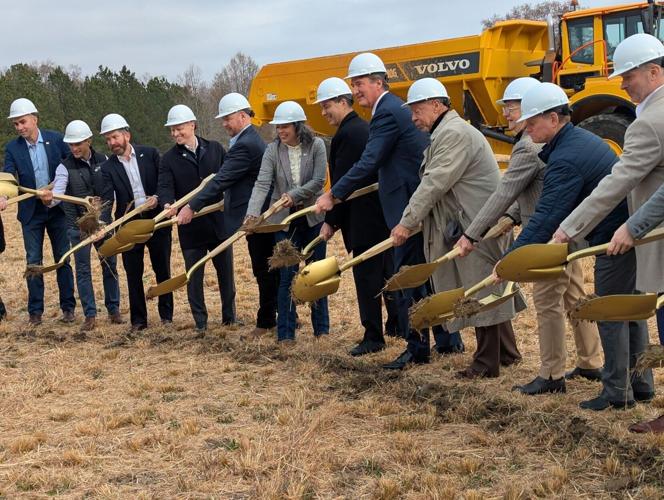
The first of several giant data centers eying Caroline County broke ground Thursday, with a $3 billion project in the first phase of a campus it plans to eventually represent an $11 billion investment in the rural county some 38 miles north of Richmond.

Gov. Glenn Youngkin and executives of CleanArc Data Centers broke ground Nov. 20 on the first $3 billion phase of an $11 billion data center campus in Caroline County.
People are also reading…

Gov. Glenn Youngkin stands with CleanArc Data Centers CEO Jim Trout.
23 historic photos of Main Street Station

05-21-1947 (cutline): Time coming back? The clocks in the twoer of Main Street Station were removed during the war when it was difficult to get replacement parts. The Chesapeake & Ohio Railway now has asked for estimats on the cost of restoring the clocks to the tower.

08-23-1941 (cutline): S.A.L. improves tracks to speed defense traffic--this picture taken from the Marshall Street viaduct, shows work in progress by the Seaboard Airline Railway Company in the vicinity of the Main Street Station. The railroad is building a double track viaduct from its Brown Street yard to where Seaboard crosses under the C&O tracks. From this point the viaduct is bring renewed to the James River. A spokesman for the railroad said the work was being done to speed up traffic from New York to Florida and aid defense transportation.

07-19-1947 (cutline): Main Street Station 'Behind Bars'

07-14-1974: Main Street Station

10-16-1975: Main Street Station

10-16-1975 (cutline): Looking down staircase gives kaleidoscopic view.

1958: Furture is questionable for Main Street Station, built at turn of the century. Seaboard, C&O study possible shift of passenger trains to Broad St. Station.

08-10-1980 (cutline): Architects David White and Larry Shifflett inspect former passenger waiting area that will be restaurant.

05-25-1946: Cargo at Main Street Station includes crates of fruits and vegetables and even several crates of pigeons.

In March 1943, teenagers visited the newly reopened Main Street Station Dining Room in Richmond, which was closed for a month to allow for remodeling required by the city. During that period, the Red Cross stepped in to supply food to World War II servicemen passing through the terminal.

In August 1969, Main Street Station in downtown Richmond sparkled in the floodwaters left by Hurricane Camille. The James River peaked at 28.6 feet in the storm.

Main Street Station fire, Oct 7, 1983.

Supports for the Richmond-Petersburg Turnpike (INCORPORATED INTO INTERSTATE 95) rise in front of Main Street Station, forming a contrast between the old and the new. 1957 photo by Ed Booth.

A street car passes Main Street Station (note the cobblestone surface for Main Street)


Main Street Station fire, the next day. Oct. 8, 1983

Main Street Station Fire the next day. Oct. 8, 1983.

In May 1948, a Seaboard Air Line Railroad diesel-powered passenger train left Main Street Station to head south. The Seaboard's main line at that time ran from Richmond all the way to Miami. A merger in 1967 renamed the company as the Seaboard Coast Line Railroad, and in 1971, Amtrak took over its passenger operations.

Floodwaters from Hurricane Agnes engulfed Main Street Station downtown on June 22, 1972.

In June 1975, southbound traffic on Interstate 95 backed up past Main Street Station as smoke billowed from a fire at Little Oil Co. in South Richmond. Two tanks holding a combined 850,000 gallons of fuel exploded at the business on Commerce Road. Fire officials believed that the ignition of an employee’s car sparked the blaze, though the oil company speculated that a lightning strike was to blame. The fire took 19 hours to extinguish.

10-10-1983 (cutline): David White (left) and Larry Shifflett stand amidst broken roofing tiles on Main Street side of station which was badly damaged in fire.

05-13-1984: Main Street Station

Left: In June 1972, the remnants of Hurricane Agnes brought some of the worst flooding in decades to Richmond, as seen in a watery entrance to Main Street Station downtown. The James River crested at 36.5 feet at the city locks. Right: In June 1948, Dewey Picklesimer poured molten iron at Tredegar Iron Works in Richmond. Tredegar opened in 1837 and was a major manufacturing center for the Confederacy during the Civil War. It survived the evacuation fire of 1865 and continued as a production facility through most of the 1950s. Today the facility houses the American Civil War Museum at Historic Tredegar.
Dave Ress (804) 649-6948