

Virginia Tech wide receiver Que'Sean Brown secures a reception during a practice last week in Blacksburg.
Virginia Tech wide receiver Que'Sean Brown secures a reception during a practice last week in Blacksburg.
Virginia Tech wide receiver Que'Sean Brown secures a reception during a practice last week in Blacksburg.
Virginia Tech wide receiver Que'Sean Brown secures a reception during a practice last week in Blacksburg.
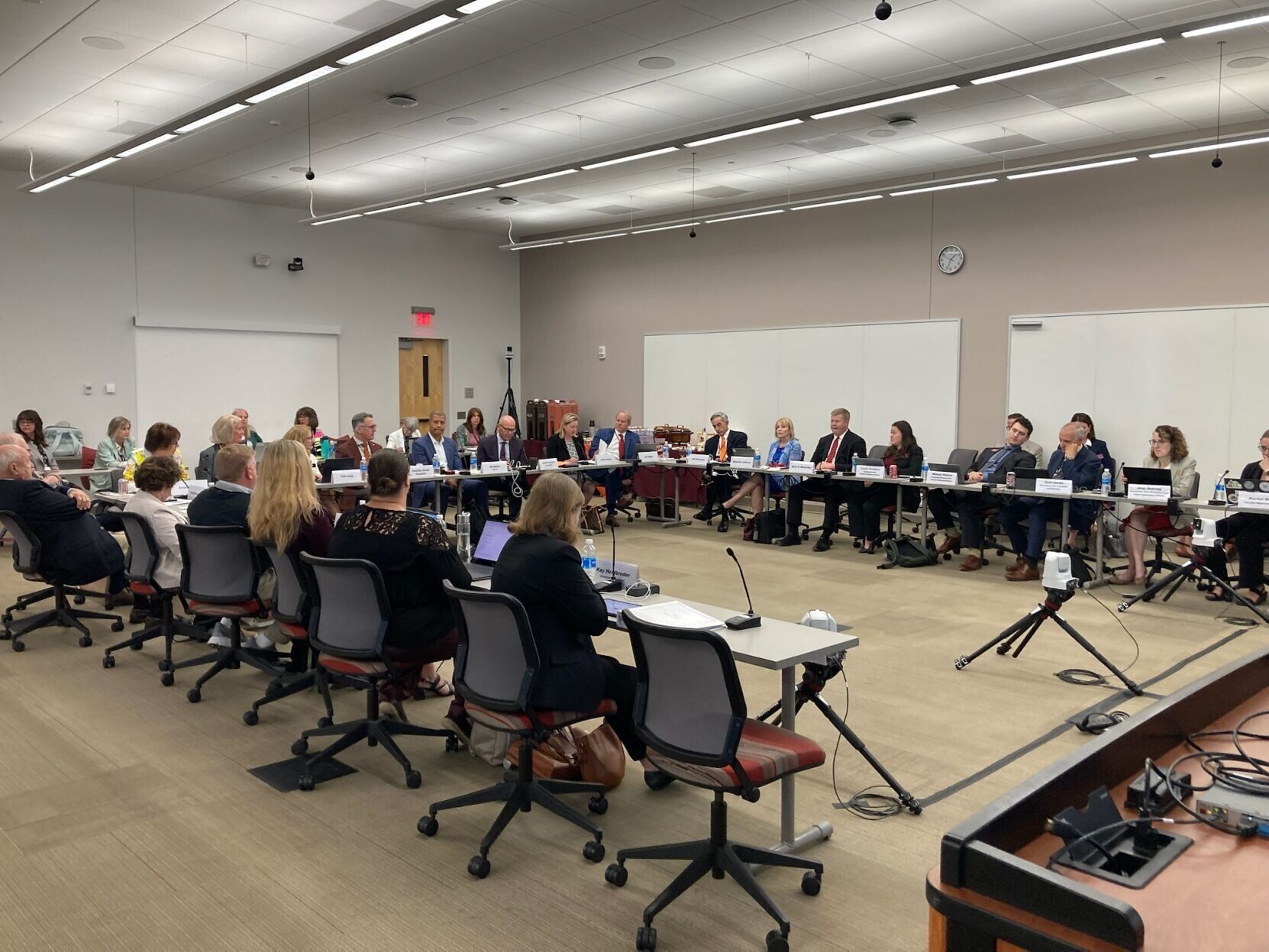
Franklin County School Board Rocky Mount District representative Jeff Worley, Superintendent Kevin Siers and Blackwater District representative Arlet Greer at Monday's monthly meeting.
A four-day school week doesn't seem likely for Franklin County students any time soon. The school board agreed Monday night to table discussion on the cost-saving measure, leaving little indication it would be brought back in the future.
"We see both opportunity and caution," said Jennifer Talley, director of elementary instruction and programs for Franklin County Public Schools, who provided results from a survey to the board.
Talley presented the survey along with Amy Johnson, the secondary education administrator for the school district. The two staff members gave the board a detailed analysis of the more than 2,000 responses to the survey.
The survey was provided to students, parents, staff and business partners in the community to give their feedback on the proposed four-day school week. The surveys were handed out last month following the school board's February meeting at which they requested additional information on the shortened school week to cut costs and possibly benefit teachers and students.
The largest group of responses was from parents and students, according to Talley and Johnson's presentation. The survey had 1,346 responses from parents or guardians and 1,593 responses from secondary students between the sixth and 12th grade.
Parents listed the benefits as having a consistent day off for appointments. They also saw the additional day away from school as a reset from stress and exhaustion and an overall improvement in wellbeing.
But nearly a third of the parents who responded listed concerns with child care access and cost. They also questioned if elementary students could maintain concentration for an extra hour of school and if students who faced food insecurity would have access to something to eat.
Among students, more than half listed reduction in stress and increase in motivation as benefits. Some of the negatives listed included concern about an additional hour of school; the additional impact of missing classes due to sickness or school activities when there are only four days instead of five; and the possible impact on advanced placement, dual enrollment, career and technical education and governor's school classes.
Nearly two-thirds of staff members responded that a four-day school week would lead to "significant stress reduction," with more than 60% responding favorably to the proposed change. Staff also listed that it would be a recruitment edge.
Some of the reservations from staff members included students not being able to maintain focus for the additional hour. Some were also concerned extra work would spill into their time off and that high-risk students would lose a day of safe connection with a trusted adult.
Community partners were the smallest number of respondents at 22 of 126 surveys returned. More than a third of respondents said a benefit of the four-day school week could be opportunities for internships and apprenticeships.
But 72% said the change could impact their business negatively. They listed possible impacts including employees balancing a new parenting schedule that could lead to a decrease in attendance.
The community partners also expressed concerns with students graduating from a four-day school week being "work-ready" after graduation.
"Honestly, for me, I think it should be tabled," said Rocky Mount District representative and Chairman Jeff Worley.
Worley said there is no way the school district could transition to a four-day week by the start of next school year. He added that there is no evidence the change would produce any substantial savings for the county.
"I just haven't seen any data that substantiates that it improves academics in students," said Arlet Greer, Blackwater District representative.
Greer added that she was concerned students could get into trouble if they were given an additional day away from school each week. She also pointed to the responses from community partners who were concerned the students would not be ready to join the workforce.
None of the board members on Monday evening provided any favorable responses to the proposed four-day school week. Following several minutes of discussion, the board gave its consensus to table the proposal with all indication that it would likely not be brought up again in the future.
"I think truly, the benefits just don't jump out," Worley said. "We will just hold off for now until something else happens."
Jason Dunovant (540) 981-3324
BLACKSBURG — Several of Virginia’s Democratic leaders said Friday they believe Virginia Tech President Tim Sands, who announced Thursday that he plans to step down, may have been forced out as Republican members of the university's board of visitors move to install a new president before Gov. Abigail Spanberger can reshape the board.
On a press call Friday morning, Sen. Tim Kaine, D-Va., said, “There may have been an effort to force Tim Sands to step down before Gov. Spanberger filled seats on the Virginia Tech board.”
Kaine added that he had spoken with people connected to Sands but was “not at liberty” to say who.
Of the 13 governor-appointed members of Virginia Tech’s board, 12 were appointed by former Republican Gov. Glenn Youngkin, while one, Edward Baine, was appointed by former Democratic Gov. Ralph Northam.
Virginia Tech Board of Visitors meets in 2025.
Spanberger will have the opportunity to make five appointments to the board in July. Four members’ terms, including Baine’s, are set to expire June 30, and one seat is currently vacant.
To avoid the Democratic governor leaving her thumbprint on Tech’s next leader, the current board — headed by Rector John Rocovich, who donated $75,000 to Republican candidates and causes last year, according to the Virginia Public Access Project — would have to choose a new president within a tight two-month window.
Sen. Creigh Deeds, D-Albemarle, said he is concerned the board plans to do just that.
“What I’ve heard is that there’s going to be an accelerated search for a president,” Deeds said Friday. “If there is, that will be further evidence that they’re operating in bad faith to get somebody in there before getting more balance on the board.”
Choosing a new university president on such short notice would be relatively unprecedented. Ahead of Sands’ appointment in 2014, a search committee interviewed 238 candidates over six months.
A person with knowledge of the situation said Spanberger has told Rocovich that her appointees to the board must be included in the search process.
“The two have spoken candidly about the need for the next president to be selected through a transparent and thorough process that does not undermine public trust in university leadership,” the person said.
However, defying the governor’s wishes on a university presidential appointment would not be unprecedented.
After University of Virginia President Jim Ryan resigned under pressure from the White House, then-Gov.-elect Spanberger asked UVa’s board to pause the hiring process until she assumed office.
The board declined to wait and named Scott Beardsley as UVa’s leader.
Soon after, five members resigned, including the rector and vice rector, who wrote, “I would love to continue serving our cherished institution, but in deference to the governor-elect’s request, I hereby resign.”
Kaine urged Spanberger to “get to the bottom” of Sands’ departure and prevent further “political schemes” in college leadership decisions, citing UVa, George Mason University and Virginia Military Institute, all of which faced President Donald Trump’s ire as his administration worked to stamp out diversity, equity and inclusion initiatives on college campuses.
Del. Sam Rasoul, D-Roanoke, who chairs the House of Delegates Education Committee, said Virginia Tech’s board has made several decisions “as of late that have been concerning,” adding that Sands’ removal “certainly adds fuel to the fire.”
Virginia Tech President Tim Sands has announced he plans to step down once his replacement is named. Some Virginia Democrats are concerned political pressure from Republican-appointed members of the university's board of visitors played a role.
The 68-year-old Sands, who came to Virginia Tech 12 years ago after serving as interim president of Purdue University, said in his farewell letter, “It is now time, while Virginia Tech has momentum on so many fronts, for me to start the process of stepping aside so that the next president can take the baton in full stride.”
Kaine and Deeds said they remain concerned that Sands did not leave entirely of his own volition. In 2022, the Virginia Tech Board of Visitors had extended Sands' contract through the end of 2027.
“I worry that he was pushed out by a partisan board. I hope I’m incorrect,” Deeds said.
Kaine said, “I think there is a desire by certain members on that board to force him out, even though he doesn’t deserve to be treated like that.”
Virginia Tech representatives contacted Friday declined to comment. The board of visitors is scheduled to meet Monday.
Richmond Times-Dispatch reporter Eric Kolenich contributed to this report.
Ethan Hunt (540) 381-1678

Virginia Tech President Tim Sands answers student Asad Khurram's questions about the university's compliance with Trump administration executi…
Gov. Abigail Spanberger has proposed extensive changes to the bills that would create a legal marketplace for cannabis, including cutting the number of retail stores, raising the tax and delaying the legislation's enactment by six months.
Late Monday, she proposed an array of changes, including cutting the number of stores in half, leaving the definition of hemp unchanged and addressing how violators are punished. Lawmakers will return to Capitol Hill next week to consider the amendments.
"We are working to set up a marketplace that is controlled, regulated and responsible – because legal markets only succeed when there are clear guardrails and enforcement to back it up," she said in a statement.
The bill's sponsors, Sen. Lashrecse Aird, D-Petersburg, and Del. Paul Krizek, D-Fairfax, said they appreciate the governor working with them to advance the legislation.
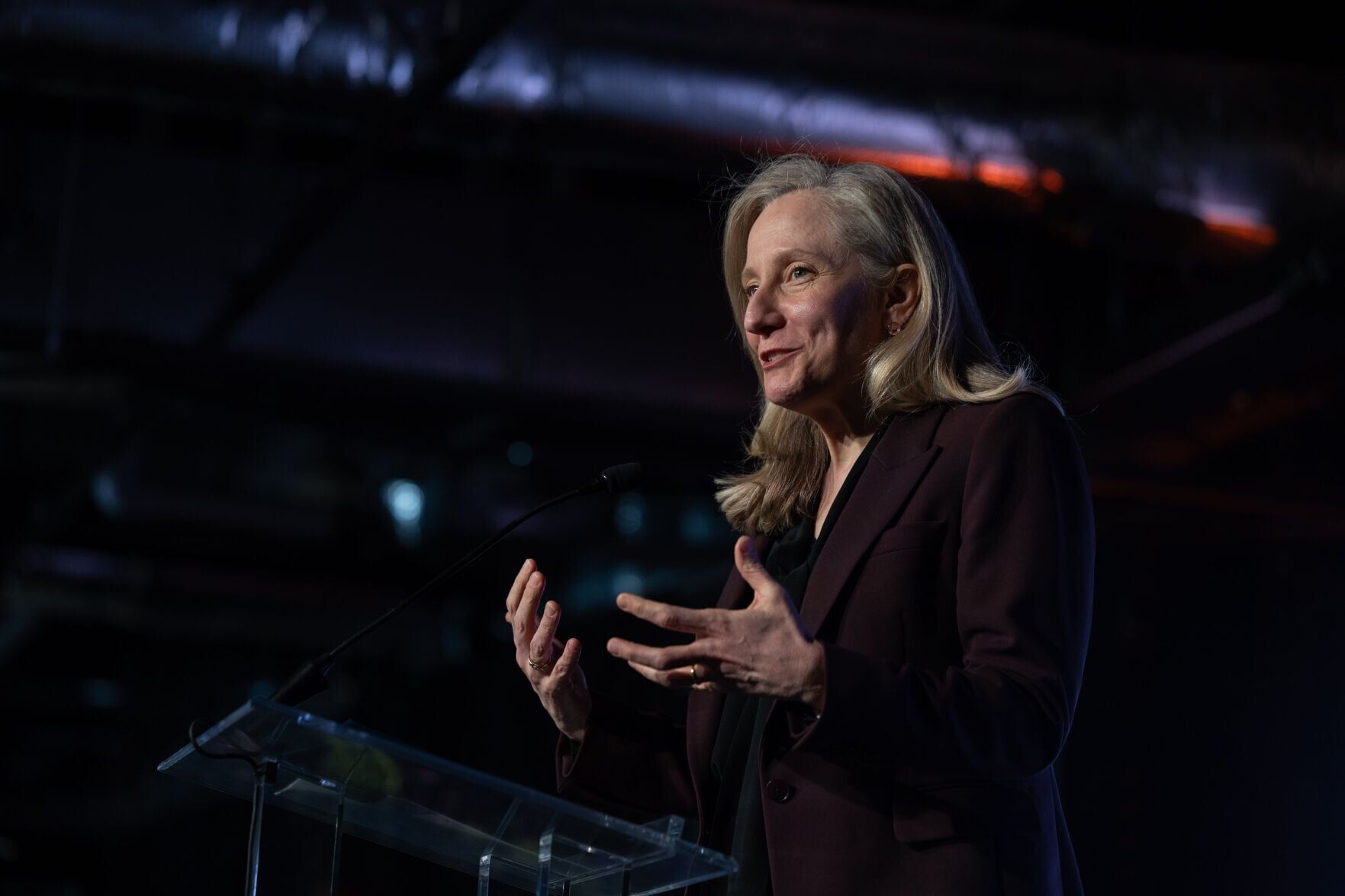
Governor Abigail Spanberger speaks at the "Expanding Freedom" ribbon cutting at Main Street Station.
If Spanberger's proposal becomes law, cannabis sales would become legal on July 1, 2027. Lawmakers had planned green lighting the industry on Jan. 1, 2027. But the governor said a later start date would help curb the illegal market.
Another change she suggested is is to limit the number of retail marijuana stores to 200, half as many as lawmakers envisioned. The bill's sponsors originally proposed 400 stores, because that's about how many Virginia Alcoholic Beverage Control Authority locations there are.
The Cannabis Control Authority's board could expand the number of stores beginning in 2029. Because it will take time for businesses to set up, if the state awards all its licenses immediately, it will benefit large, established companies at the expense of small businesses, experts said.
While the bill originally capped the number of licenses for wholesalers, cultivation facilities and manufacturing facilities, Spanberger's proposal allows as many licenses as necessary for these locations.
Finances are different under the governor's revisions, too. Spanberger proposed raising the cannabis tax to 8% on July 1, 2029. Lawmakers proposed a 6%, which would be charged in addition to the state sales tax and local add-on taxes. Altogether, buyers would pay between 12% and 16.5%. Krizek said he wanted a relatively low tax rate to encourage people to buy cannabis legally.
The governor also suggested changes to how the money is spent. The bill originally proposed specific requirements for how cannabis tax revenue would be spent. Spanberger has suggested more vague language, saying the money would go to "purposes such as" early childhood education, behavioral health, public health awareness, reinvestment in historically disadvantaged communities and other initiatives.
The governor proposed tougher punishments on illegal sellers. Processing marijuana illegally would be a Class 6 felony, punishable by up to five years in prison. She suggested a range of punishments for illegal growers based on the number of plants and whether it is the suspect's first offense. A person who cultivates 100 plants or sells 50 pounds of marijuana can be charged with a Class 3 felony, punishable by a 20-year prison sentence.
"To keep our next generation safe, we must also ensure real consequences for vape shops that have spent years targeting Virginia's kids," Spanberger said.
She also doubled the amount of cannabis an adult can legally carry, from one ounce to two ounces.
Spanberger also proposed leaving the definition of hemp unchanged in the bill. Late in the legislative process, lawmakers wrote in a new that would have banned any hemp product with more than 2 milligrams of total THC per package. Current Virginia law allows hemp products that have no more than 0.3% THC and a 25-to-1 ratio of CBD to THC.
Aird said the change was made to close the "loophole" that allows hemp products to circumvent THC limits. More limitation on hemp would ensure those products don't undercut the marijuana market.
But hemp supporters objected to this provision. Del. Tom Garrett, R-Buckingham, said it would put Virginia employers out of business and create an unfair advantage for large marijuana cultivators.
Addressing business ownership, Spanberger proposed that the Cannabis Control Authority require that marijuana businesses disclose their ownership and gain approval if a business is sold. In Maine, the cannabis industry has been weighed down by organized criminal networks from China, authorities said.
"Our ongoing collaboration reflects a shared commitment to launching a responsible, inclusive cannabis market that protects consumer health and safety, combats the illicit market and delivers for communities across Virginia," they said in a shared statement.
A number of other small changes dot the bill. Spanberger suggested many new definitions and titles, including renaming the "cannabis business equity and diversity support team" to the "cannabis impact business support team." She struck a requirement that the team create diversity, equity and inclusion plans for the cannabis industry.
Spanberger wrote in a clause calling for officials to issue an annual report on the health of the state's marijuana market, providing information on sales, jobs created, disciplinary actions taken, programs funded by cannabis taxes and a comparison between the legal market and the illicit market.
She also made it easier for businesses to obtain impact licenses, which are special licenses to grow and sell cannabis for people from disadvantaged communities or who have been negatively impacted by past marijuana laws.
Another suggested change came to House Bill 26, which would allow people in jail for marijuana-related crimes to receive a hearing and possibly receive an early release. Spanberger proposed not allowing defendants convicted of violent crimes to receive a lessened sentence.
Eric Kolenich (804) 649-6109

Based on the analysis, five of the top 10 safest cities in the U.S. are located in one state.
An 18-year-old man was killed Sunday in a single-vehicle wreck in Franklin County.
At about 1 a.m., a Ford F-250 pickup truck was traveling on Naff Road, approximately one and half miles west of its intersection with U.S. 220, when it ran off the left side of the road and down an embankment, Virginia State Police said.
The truck then overturned, ejecting its driver.
Zebadiah Blaze Peery, of Boones Mill, died at the scene. He was not wearing a seat belt, police said.
Laurence Hammack (540) 981-3239