RICHMOND — The Virginia State Bar on Friday suspended for three years the license of Holland Perdue, the mayor of Rocky Mount who practices law in his hometown, for what a bar attorney called “deceitful and dishonest” behavior in a civil case.
The decision by a five-member disciplinary board came after it found Perdue violated the bar’s rules of conduct in a variety of ways during his representation of a widow who was seeking a share of her late husband’s estate.
“Mr. Perdue’s conduct wreaked havoc on everyone in that case,” Deputy Bar Counsel Edward Dillon told the board.
At the heart of the misconduct complaint was a court document that Perdue filed, attesting that he had met the deadline to bring a complaint in Franklin County Circuit Court — when in fact it was filed more than a month late, leading to its ultimate dismissal.
![]()
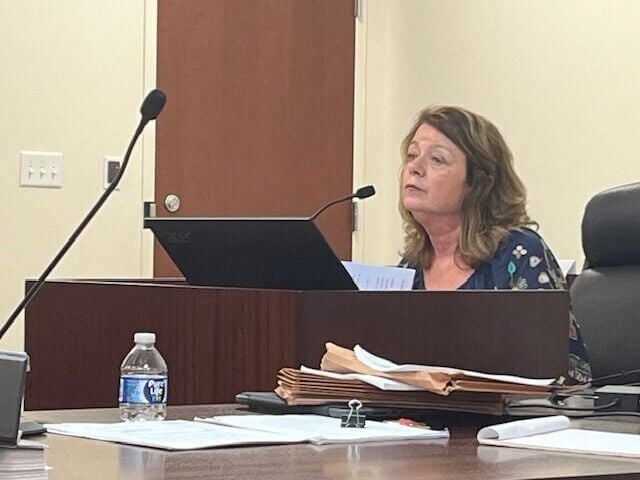
Teresa Brown, clerk of Franklin County Circuit Court, testifies
at Holland Perdue's misconduct hearing before the Virginia
State Bar on Friday.
LAURENCE HAMMACK, The Roanoke Times
Teresa Brown, the longtime clerk of court, testified that shortly before Perdue filed the lawsuit on Sept. 23, he came to her office with an unheard-of question.
“Mr. Perdue asked me if there was any way I could backdate a filing” to reflect that it was filed before the statute of limitations expired, Brown testified during a two-day hearing. “I told him absolutely not.”
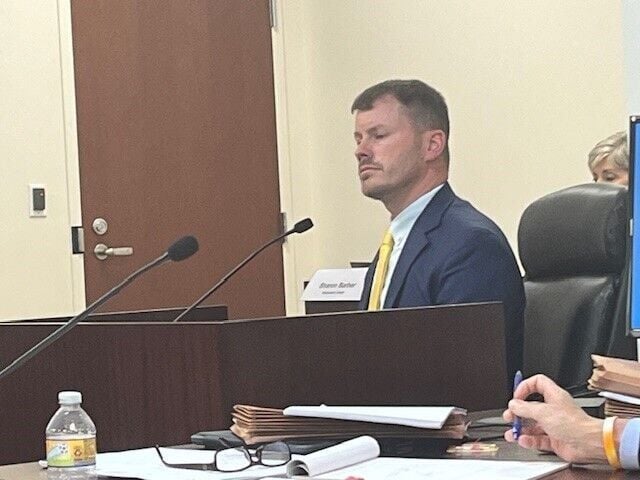
Perdue denied the accusation, which came from a longtime friend in the close-knit community. “I absolutely did not,” he said when his attorney, John Lichtenstein, asked if what Brown said was true.
What happened in the case at issue?
In 2024, Perdue was representing Valerie Venning, who was not listed in the will of Greg Venning, a developer who owned multiple properties around Smith Mountain Lake. Perdue filed what’s called a claim for an elective share, which would have entitled his client to collect part of what Greg Venning had left to his four daughters.
State law required that a corresponding lawsuit be filed within six months, or by Aug. 21.
Although he did not file until Sept. 23, Perdue objected to a request by the daughters’ attorney, Lindsey Coley, who argued that the lawsuit was time-barred and should be dismissed.
He filed a response the following month that stated: “On Aug. 20, 2024, Perdue filed a complaint to protect the plaintiff’s rightful share.” Attached to the response was a print-out of a screen shot — taken from the court system’s secure online platform — that showed an Aug. 20 filing date.
How the court record was altered, and who did it, remains a mystery in the convoluted case.
“That’s the question I would like an answer to myself,” Brown testified. “I don’t know the answer.”
Under questioning from their boss, all 11 deputy clerks in the office denied they had a hand in the fraud. Brown then made a report to the Virginia State Police.
The state bar gets involved
After an investigation, a special prosecutor determined there was no evidence to support a criminal charge against the mayor of Rocky Mount.
But Perdue fell under scrutiny of the state bar, which sets a lesser standard of “clear and convincing” evidence for violations of the code of conduct by which all Virginia lawyers are required to abide.
Retired Judge William Broadhurst, who was appointed to hear the civil case, made a complaint to the bar in March 2025, writing about what he called a “concocted exhibit” in the document that Perdue signed.
Coley, who earlier in the year had filed a motion in Circuit Court asking that sanctions be imposed against her opposing counsel, followed with a second complaint in April.
![]()
Holland Perdue testifies at his Virginia State Bar hearing on
Thursday.
LAURENCE HAMMACK, The Roanoke Times
In defending his actions to the bar’s disciplinary board, Perdue argued that everyone involved in the case knew his complaint was filed late on Sept. 23, a fact that was made clear in the same filing that purported an Aug. 20 date.
His defense centered in the word of a paralegal in his office, who testified that she inserted the offending language in the document after finding the mysterious screenshot in a collection of court documents gathered by Perdue’s office.
Laura Gall testified that after finding what was called the “golden ticket” that solved the case for Holland, she inserted the screenshot and supporting language in the court document, not knowing that it was erroneous. Perdue signed the pleading and filed it with the court.
Perdue testified that he had reviewed and approved earlier drafts of the 16-page document but did not read the version that Gall had prepared. That was his mistake, he acknowledged.
“You learn a lot sitting in this chair,” he said from the witness stand.
Gall’s testimony was questioned by several members of board. She did not unequivocally deny telling a state bar investigator that she had no memory of inserting what became known as “paragraph 44” of the filing, or saying that Perdue would be mistaken if he said that she did.
But Gall said she didn’t have the documents in front of her during the telephone interview, during which she took offense to the investigator’s questions about her being “thrown under the bus."
“Quite frankly, I didn’t appreciate being intimidated,” she said. “I was feeling pretty bristly about how I was being treated... and my goal was to get off the phone.”
Regardless of who altered the court’s website to show the Aug. 20 filing date, Brown said she was “devasted” when she found out what had happened.
“I feel like that has affected my reputation and the integrity of my office,” she said.
Brown became emotional — dabbing her eyes with a tissue at one point — while delivering damaging evidence about a man she said she had known, and liked, “all his life.”
Working in the clerk’s office for nearly 40 years, Brown was close to Perdue’s father, the late Clyde Perdue, a Circuit Court judge in Franklin County. And the younger Perdue once took her daughter to high school homecoming dance.
Coley also failed to hold back tears in her testimony during the second phase of the hearing, when the board was considering how to sanction Perdue for what he did. She described getting angry calls from people who had heard about the case.
“I feel like my name was being dragged through the mud, and I don’t think that was warranted,” she told the board.
Perdue’s punishment
At the conclusion of the hearing, Dillon asked that Perdue be disbarred. Lichtenstein appealed for mercy, saying that his client had no prior history of bar complaints and was well regarded in Rocky Mount as both a lawyer and mayor.
“It’s an aberration in his practice; he’s never been here before,” he said during the bar hearing in downtown Richmond.
In testimony that went into Thursday night, Perdue was asked about a social media post he made last April that mentioned the motion for sanctions in reference to his position as mayor of Rocky Mount.
“Unfortunately, it is no secret that political leadership comes with politically targeted attacks,” the entry stated.
Perdue said he was peeved with The Roanoke Times, which he knew was going to publish the next day what became the first of several stories about the case.
As part of a settlement agreement, Perdue agreed to pay Coley $50,000 for her expenses in defending her motion for sanctions. He also agreed to retract his Facebook statement with the following post:
“After further consideration, I do not believe the motion for sanctions to have been politically motivated,” it stated, “but rather based on factual statements included in a pleading I filed, which were incorrect.”