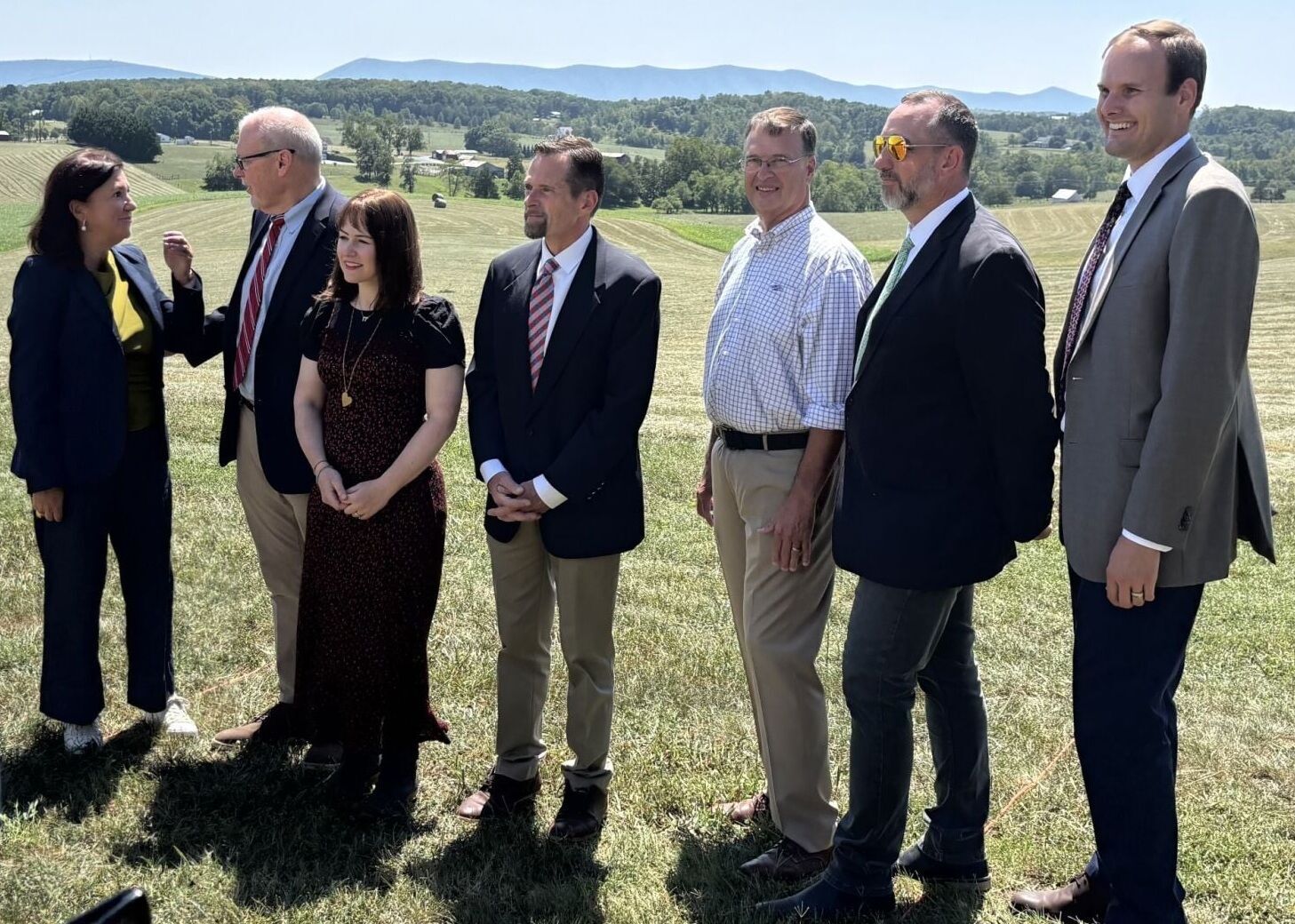
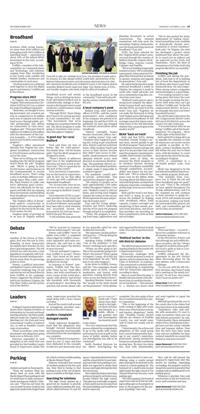
MONETA — Bedford County Supervisor Edgar Tuck’s family farm in Moneta, among the roughly 1,600 county addresses that will get high-speed internet through the Broadband Equity, Access, and Deployment (BEAD) program, laid out the welcome mat Aug. 25 for a milestone announcement.
Arielle Roth, assistant U.S. secretary of commerce for communications and information, announced at Tuesday's gathering that all 56 state and territory BEAD projects have been approved, marking the final step toward closing the digital divide for communities across the country.
“With all 56 Final Proposals now approved, we are achieving Congress’s vision of closing the digital divide once and for all. I am thrilled to join Congressman Griffith to see how Virginia is implementing its Final Proposal,” Roth said in a news release.
Roth, administrator of the National Telecommunications and Information Administration (NTIA), marked the milestone while joined by U.S. Rep. Morgan Griffith, R-9th District, who represents Bedford County; Chandler Vaughan, director of the Virginia Office of Broadband, and Ashleigh de la Torre, vice president of public policy for Amazon.
The majority of Bedford County’s BEAD project area will be connected through fiber from ZiTEL, a Moneta-based internet service provider, while SpaceX and Amazon will provide low-Earth-orbit (LEO) broadband to the remaining addresses.
Under the state’s final proposal, BEAD will connect more than 85,000 locations while saving taxpayers more than $930 million and leveraging nearly $430 million in matching funds — equivalent to about 45% of the federal BEAD investment in the state, according to NTIA.
Griffith, a member of the Subcommittee on Communications and Technology, said solutions ranging from fiber installation to low-Earth-orbit satellite will benefit families, businesses and communities in rural areas.
“I look forward to our continued work together to close the digital gap in rural America,” Griffith said in the release.
Progress since 2017
In Virginia, the creation of the Virginia Telecommunication Initiative (VATI) in 2017 was a catalyst for major broadband expansion.
“Back then, we thought it was a big investment, but a modest one now in comparison to $1 million each year to expand rural broadband access through public-private partnerships and deliver on connectivity in rural areas,” Vaughan said. “That grew from $1 million to $5 million to $50 million with the investment of the General Assembly … to $750 million back in 2022 to drive connectivity progress.”
Vaughan’s office announced Monday that Virginia has completed broadband construction to 250,000 homes and businesses across the state.
“Now we're hitting our stride heading into the BEAD program that'll finish the job,” Vaughan said. “BEAD is going to fund 85,000 homes and businesses in the Commonwealth to receive broadband access. That's using a mix of multiple different technology types: fiber, cable, satellite, fixed wireless to make sure we're delivering good connectivity, but efficiently for the taxpayers and folks that are enjoying these investments and benefiting from broadband service in these communities.”
The Virginia Office of Broadband expects construction to begin in October and complete all projects by the end of the decade, if not sooner, he said.
Vaughan spoke of growing up in an area of Virginia without broadband access and certain things, such as driving two hours to get specialized medical care at Charlottesville, Raleigh or Richmond or driving into town to send emails for a small business, being normal activities.
“Through BEAD, those things don’t have to be normal anymore in rural communities,” he said. “The investments that we’re making now are going to finish the job. The BEAD program is really going to transform rural economies throughout Virginia.”
'A good day' for rural Bedford
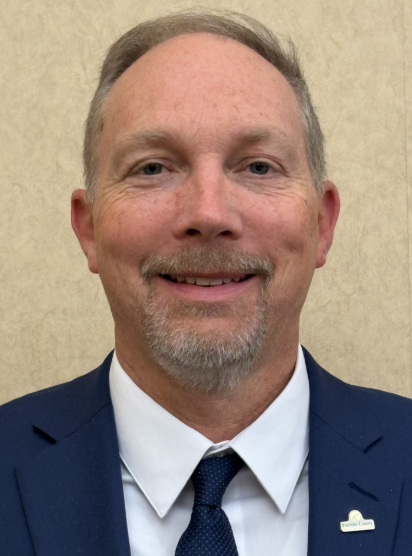
Tuck said there are tons of homes like his sixth-generation family farm, “off the beaten path,” that the BEAD program is designed to reach.
“There's dozens of addresses right here in the neighborhood that have not been served so far,” Tuck said. “This is a good day for this part of the county.”
Tuck, the District 2 representative on the board of supervisors, said he first ran for that office 10 years ago with a platform of dependable broadband.
“So, 10 years later, here we are, and we're on the cusp of universal coverage in Bedford County,” he said.
Tuck referred to ZiTEL as a premier provider for the county and said that since broadband began to roll out in Moneta, many people have been able to work remotely, and household income has increased by $12,000 per household in the past five years.
“I will attribute that primarily to the broadband access in the community,” Tuck said in describing the various community benefits of it.
A local company's push
Rodney Gray, chief executive officer of ZiTEL, said the county government’s early confidence in the company was pivotal in its beginning. He said the COVID-19 pandemic six years ago changed the national conversation about broadband.
“Almost overnight, homes became classrooms, offices, doctors’ waiting rooms,” Gray said. “Students were trapped in parking lots, trying to get schoolwork done. Parents could not work from home. Older residents tried to get access to their doctors because they didn't have access to telehealth. Small businesses without adequate internet access were placed at an enormous disadvantage. The pandemic did not create the rural broadband problem. It simply made it impossible to continue to ignore.”
The pandemic created public-private partnerships that spurred the company’s growth.
“We employ 63 people; we've built approximately 1,500 miles of fiber throughout Virginia,” Gray said. “Bedford County is still our home, and serving rural Virginia remains the center of who we are. BEAD represents the next and perhaps final major push.”
Gray said the Trump administration and Roth’s leadership had the NTIA push the program through and get it accomplished.
“Today, the program is moving from maps, applications and planning documents to actual construction. The renewed momentum will help push the remaining Virginia communities over the hump and bring universal broadband,” Gray said.
ZiTEL has been selected for five Virginia BEAD project areas, serviced through the counties of Bedford, Roanoke, Augusta, Rockbridge, Galax, Grayson, Carroll, Culpeper and Franklin.
“We're not building temporarily isolated systems. We're extending a permanent, interconnected Virginia Fiber Network that we intend to operate, maintain and upgrade for generations,” Gray said.
He said in the final push to make universal broadband a reality in Virginia, his company is ready to create jobs, build networks and serve communities long after construction crews leave.
“Bedford County gave us, gave a young local company the opportunity to prove itself, and companies like ZiTEL are ready to do the work,” Gray said. “Together, we can make the final push to bring rural Virginia across the hump and gain universal broadband. It will no longer mean that where somebody wants to live will determine whether they can participate in the modern world.”
BEAD 'back on track'
Roth said that NTIA, during President Donald Trump’s current term, moved quickly to get the BEAD program “back on track” by working to remove red tape and open it to any provider that could meet the program’s requirements: satellite, fixed wireless and fiber.
“After years of delay, we returned the BEAD program to its statutory mission, ensuring universal broadband availability through competition, accountability and respect for the law,” Roth said. “We've reduced taxpayer costs by $21 billion while securing almost $12 billion in private matching funds, an important indicator of provider commitment and the long-term success of these projects.”
Roth said the work is not done, and NATI is doing its part to ensure the buildout by helping state broadband offices build capacity, conduct oversight and monitoring of their awards, prevent fraud and abuse, and ensure that providers are executing on their commitments, both on time and on budget.
“We've also pushed for faster deployment by making cloud-based permitting tools available to dramatically shorten environmental or review timelines,” Roth said. “In Virginia, the state has developed a project status dashboard that allows the public to search for an address and see expected service levels and timeframes. That's the kind of transparency that helps hold a big program like BEAD accountable.”
Finishing the job
Griffith said during the pandemic, kids had to sit in parking lots of local fire departments or the library after hours to get their homework done. He said competition among various companies and technologies is a good thing.
“I'm looking forward to marketing plans that lower the costs for the people receiving the low-Earth-orbit when they can't get the fiber," Griffith said. "In the 9th congressional district, we have a lot of people who have a lot lower household income."
He said the latest data shows the 9th Congressional district ranks 409 out of 435 districts across the country for take-home pay.
“I’m excited about what we are doing,” Griffith said of the broadband push. “It’s a big deal … We’re within sight of the finish line.”
Roth said NATI is doing all it can to expedite the timeline so that all Americans can receive service as quickly as possible. In Virginia, contract deadlines mostly fall within the next two to three years, with the hardest-to-reach areas due by the end of the decade, according to Vaughan.
ZiTEL is committed to a 34-month project scale, Gray said.
BEAD was designed to be the last federal broadband infrastructure subsidy program, Roth said.
“The mandate from Congress was to finish the job and close broadband gaps for good,” she said. “That is the standard we have upheld throughout the Trump administration, and it is the standard we will continue to hold ourselves to going forward. NTIA will remain focused on execution, making sure funds are used responsibly, projects are built, and communities get the service they are promised.”
Editor's note: This article first published Aug. 28, 2026.