

Va. Democrats to end up with 8-3 map — without redistricting

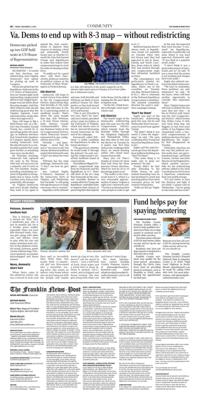
U.S. Rep. John McGuire, R-5th, greets supporters at his election night watch party on Tuesday at First Free Coffee Bar in Albemarle County.

Democratic congressional candidate Tom Perriello speaks to reporters at a polling location in Goochland on Tuesday.

Elaine Luria, center, celebrates with her daughter Violette, left, and her husband Robert Blondin, right, after declaring victory in Virginia’s 2nd District at the Holiday Inn Virginia Beach - Norfolk in Virginia Beach on Tuesday.
RICHMOND — It turned out that elections, not redistricting, were Virginia Democrats' best option for picking up seats in Congress.
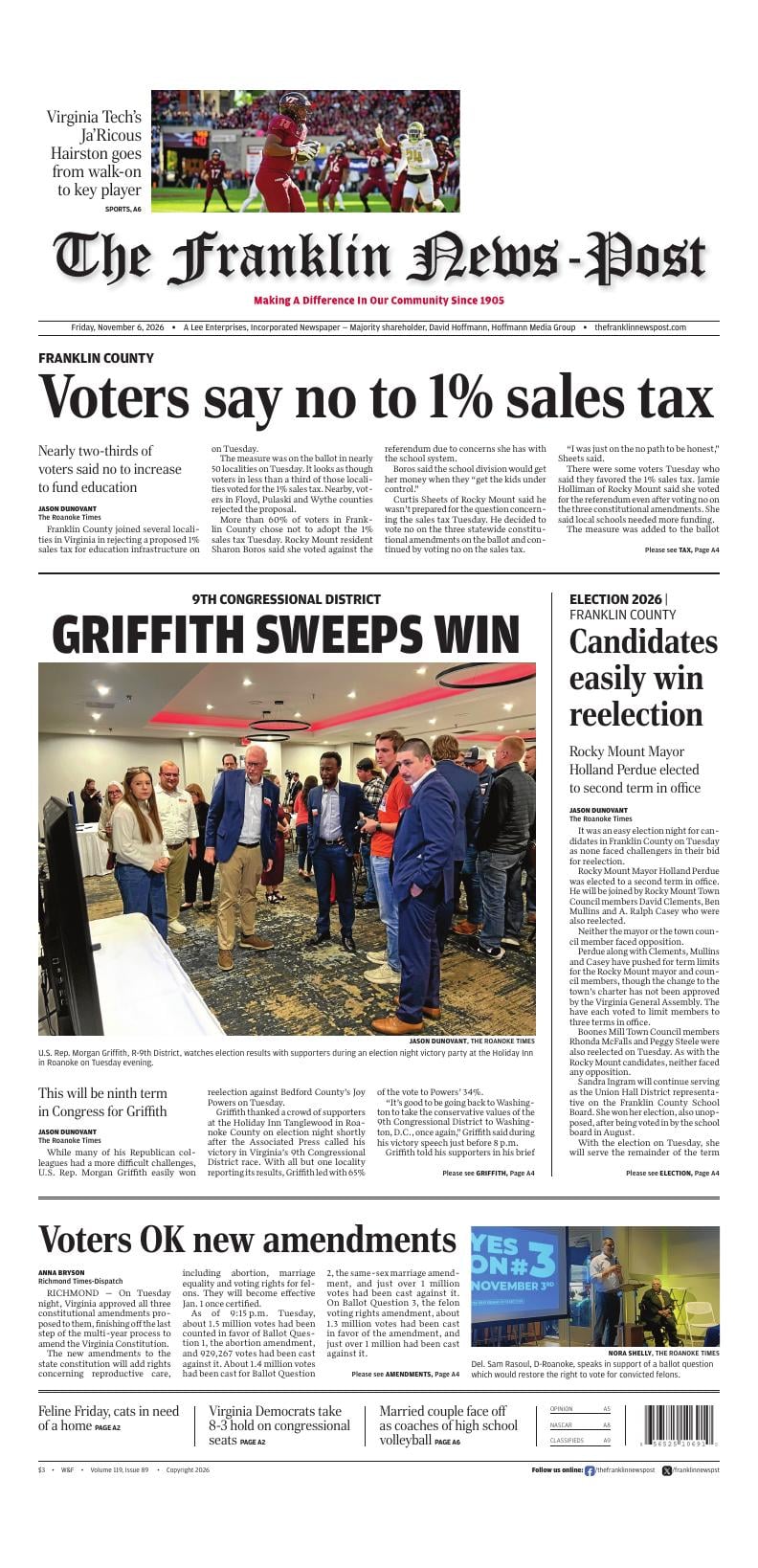
Democrats picked up two Republican-held seats in the U.S. House of Representatives on Tuesday night, both representing congressional districts that Abigail Spanberger won last fall by about the same margins. And they did it without a mid-decade redistricting push that the Virginia Supreme Court rejected in May, weeks after voters had approved it.
They still hope to flip a third House seat, in a district that President Donald Trump has carried by 12 percentage points two years ago, in midterm elections that turned both chambers of Congress upside down, turning Democrats from the minority party to a comfortable majority that could grow further as remaining close races are decided.
By Thursday morning, Democrats had captured 241 seats in the House, with only 218 necessary for a majority, and 54 seats in the 100-member Senate, including astonishing victories in Republican strongholds such as Texas, South Carolina, Iowa, Kansas and, potentially, Mississippi.
So, Virginia Democrats now must decide whether they want to try again to amend the state constitution to improve their chances of winning a third and potentially fourth House seat, or whether it's worth the risks that burned Trump and Republicans in states that redrew their congressional maps to stack the odds of winning in their favor.
"It might not be a great idea," said Steve Farnsworth, professor emeritus of political science at the University of Mary Washington in Fredericksburg.
5th District
Democrats still hope to snatch victory from defeat in the 5th Congressional District, where former Rep. Tom Perriello, D-5th, trails Rep. John McGuire, R-5th, by 2.2 percentage points in unofficial results. That's about the same margin that Rep. Rob Wittman, a 19-year House veteran, trails Henrico County Commonwealth's Attorney Shannon Taylor in the 1st Congressional District, which Democrats haven't represented in any configuration since 1976.
Perriello — and Spanberger — insist that the race is "too close to call," but veteran Richmond political analyst Bob Holsworth said, "I don't see where the votes are."
Wittman has the same challenge, Holsworth said. "I don't see how he gets there."
Sen. Lamont Bagby, D-Henrico, chairman of the Democratic Party of Virginia, said Wednesday that Perriello "is still going through the process to make sure every vote is counted."
Regardless of the ultimate outcome, both Perriello and Wittman are likely to have political futures for their parties, as they look toward the next governor's race in 2029 and beyond.
"This is not (Perriello's) last race, that's for sure," said Larry Sabato, president of the Center for Politics at the University of Virginia, which had shown races in the 1st, 2nd and 5th leaning toward Democrats by the end of the campaign.
Farnsworth called Wittman "a viable candidate for Republicans to offer in future elections."
"The question is whether he would make it through the primary," he said, noting the congressman's relatively moderate brand of conservatism.
The midterms flipped Virginia's congressional map from six Democrats and five Republicans to 8-3. That's still short of the 10-1 map that Democrats in the General Assembly devised to counter efforts by Trump and Republican-controlled states to improve their chances of preserving their slim majority in the House, but the odds of winning the 5th aren't likely to improve soon.
"In the 5th, I think Perriello is the high-water mark," Sabato said.
6th District
The fourth target of the Democratic redistricting plan this year was the 6th Congressional District, which extends from the Roanoke Valley through the Allegheny Highlands and Shenandoah Valley. Rep. Ben Cline, R-6th, won the district on Tuesday by 11 points over first-time Democratic challenger Beth Macy, an award-winning author who raised more money than he did.
Macy also cut Cline's margin of victory by more than half from his three previous House elections, which he won by 28 or 29 percentage points each.
"The reality is the Democrats have 8-3, which is a very reasonable approximation of where Virginia is right now," Holsworth said. "You have to disenfranchise some people in order to get to 10-1."
Redistricting also doesn't always work, as Republicans found out painfully on Tuesday when they lost House seats they had expected to win in Texas, Florida and North Carolina, three states in which they had pushed through new congressional maps that ultimately backfired on them.
The comeuppance was particularly painful for Republicans in North Carolina, where one of the casualties on Tuesday was Rep. Richard Hudson, R-N.C., who is chairman of the National Republican Congressional Committee. The national committee directed the party's midterm campaign strategy.
'Don't be them'
Bagby was part of the Democratic redistricting push this year, but he said Wednesday that it was necessary to push back against Trump.
"We didn't think it was worth it from the beginning," he said. "We were countering what Trump had forced the Republican states to do."
Bagby said the main lesson he got from the Republican midterm drubbing was "don't be them."
"The main thing is to make sure to keep our promises," he said.
Trump didn't do that after returning to the White House, he said, instead launching wars he had promised to avoid and pursuing policies that raised consumer prices he had vowed to bring down.
"Folks are fed up," Bagby said.
In the end, the expected blue wave became "a tsunami" for Republicans, especially in politically red areas where it was least expected, Holsworth said. "It was kind of a populist revolt, really."
"I don't think it was a great endorsement of Democrats, per se," he said. "It was a sense that the system is not working and changes have to be made."
Bagby also advised caution to his fellow Democrats.
"We have to remember, these positions are only temporary," he said. "In two years, voters will have another opportunity to consider who represents them."
Then, Virginia Democrats will have to defend the two seats they just won — in the 1st District with Taylor and the 2nd Congressional District, which former Rep. Elaine Luria, D-2nd, won back from Rep. Jen Kiggans, R-2nd. Four years earlier, it was Kiggans who vanquished Luria, a two-term congresswoman, in midterm elections that gave Republicans the majority that disappeared on Tuesday.
Ultimately, elections are the way the political system works best, not gerrymandered maps, said Brian Cannon, former executive director of OneVirginia2021, which pushed successfully for the redistricting reforms added to the State Constitution in 2021 to have a bipartisan commission draw new political maps.
"It's just better to have fair districts and fight it out fairly," Cannon said on Wednesday. "You're going to win some and lose some."