
Officials say Virginia Tech is ‘perfectly positioned’ for more defense research funding

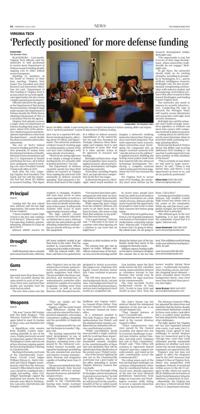
Rector Jim Miller, middle, is seen during the June 2 Virginia Tech Board of Visitors meeting. Miller said Virginia Tech is "perfectly positioned" to grow its Department of Defense funding.
BLACKSBURG — Last month, Virginia Tech officials said the university is well positioned to receive more Department of Defense research funding despite ongoing cuts to other federal research programs.
Speaking to members of the Board of Visitors at their June meeting, Virginia Tech Senior Vice President and Chief Research and Innovation Officer Dan Sui said, “Department of War funding at Virginia Tech is an area where we see both significant opportunity, but also a more complex operating environment.”
Officials referred to the agency as the Department of War during the presentation, though its legal name remains the Department of Defense despite the White House adopting Department of War as a secondary title for the agency.
Virginia Tech already receives a larger share of Department of Defense funding than many of its peers. About 26% of the university’s federal research and development expenditures come from the department — nearly double the share received by universities nationwide.
The rest of Tech’s federal research funding portfolio consists primarily of money from the National Institutes of Health, National Science Foundation and the U.S. Department of Health and Human Services, all of which have undergone research funding cuts since President Donald Trump took office in 2025.
Soon after the cuts, outgoing Virginia Tech President Tim Sands and Sui said the university had lost about $21 million in research funding. That figure later rose to a reported $54 million in terminated grants, affecting about 30 offices and departments. The university maintains a federal research tracking page to catalog updates as many of the cuts face court challenges, with some already struck down.

Dan Sui, Virginia Tech's senior vice president and chief research and innovation officer, is pictured.
“What we are seeing right now is not simply a change in federal funding levels, it's a broader shift in federal priorities,” Sui said.
The Department of Defense currently spends less than $100 million on research at Virginia Tech, ranking the university 20th nationally in defense research spending. That represents a relatively small share of the roughly $1.6 billion in federal research expenditures at the university, but Sui and Vice President for Strategic Alliances Steve McKnight said Virginia Tech is well positioned to grow that total if it takes specific action in its approach to research and funding.
McKnight outlined a four-stage research pipeline: basic research, applied research, advanced technology development and higher technology maturity.
Universities, including Virginia Tech, are typically most competitive in the first two stages.

McKnight
To illustrate the process, McKnight asked board members to imagine a university studying molecular interactions that produce a new hard compound. That work represents basic research, where universities excel. Developing the compound into an impact-resistant material with “specific interest to the military” is applied research. Building and testing armor panels made from that material falls into advanced technology development. Producing a complete armored vehicle represents the final stage, where the DOD has invested the most.
For Virginia Tech to secure more DOD funding, the university must move further up the research development ladder, McKnight said.
“The opportunity is real, but it occurs at later stage development, where universities traditionally do not engage,” McKnight said.
To get there, the university should build on its existing strengths, including its proximity to Washington, D.C., and its artificial intelligence research, McKnight said. He also recommended strengthening relationships with industry leaders and pursuing long-term federal contracts that allow research to flow toward Washington and funding toward Virginia Tech.
The university also needs to improve its security infrastructure. Conducting the type of research the Pentagon wants will require secure laboratories and researchers with high-level security clearances.
McKnight also said the university must build stronger workforce pipelines so students can move into careers with companies involved in defense research.
Looking ahead, he said the university must determine where to invest first while continuing strategic planning efforts.
Newly elected Board of Visitors Rector Jim Miller said securing additional DOD funding is “an area that is really important to me and a number of other members of the board.”
“This is certainly an area where we will need to make investments,” he said. “There is real money here, and there's a real opportunity in front of us, and we are perfectly positioned.”
Ethan Hunt (540) 381-1678