
Judge Michael Urbanski to retire after long tenure on the federal bench

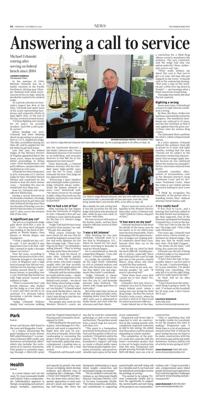
U.S. District Judge Michael Urbanski will retire effective Sept. 30. He is photographed in his office on Sept. 18.
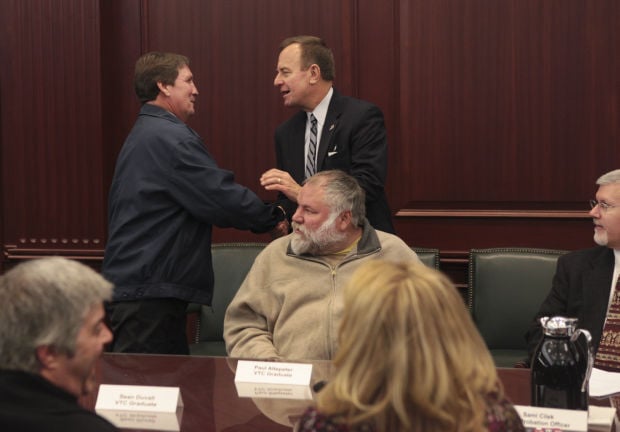
Judge Michael Urbanski, standing center, shakes hands with Veterans Treatment Court graduate Ronald Taucher. Fellow VTC graduates Sean Duvall, seated left, and Paul Altepeter, seated center, and probation officers Poe Cobb and Sami Cilek wait for the arrival of U.S. Attorney General Eric Holder.

U.S. District Judge Michael Urbanski, who will retire effective Sept. 30, second from left, is pictured with his law clerk team, from left, Linda Kring, Natalie Beers and Jennifer Willis, in his office on Sept. 18.

U.S. District Judge Michael Urbanski, second from left, talks with his law clerk team, from left, Linda Kring, Jennifer Willis and Natalie Beers, in his office on Sept. 18.
In the summer of 2003, Michael Urbanski was on a family vacation in the Pacific Northwest, driving near Olympic National Park while everyone else in the car slept, when he decided he wanted to be a federal judge.
As a private attorney for Roanoke’s largest law firm at the time, Urbanski had spent most of his career representing businesses and corporate clients in legal fights that, at the end of the day, revolved around money.
“I’d been fighting over money for 20 years,” he recently recalled, “and I felt a call to public service.”
Before heading out west, Urbanski had been thinking about an upcoming vacant position as a U.S. magistrate judge. The idea crystallized during his time off, and he applied for the job when he got back home.
Late that year, the federal judges of the Western District of Virginia appointed him to the lower court, where he handled initial proceedings in felony cases, tried misdemeanors and petty offenses, and presided over mediation in civil cases.
Urbanski was then nominated, in 2011, to become a U.S. District judge by then-President Barack Obama and confirmed by the Senate to hear the more serious cases — including the ones he would later lose sleep over.
Now 69, Urbanski will retire effective Wednesday.
During a recent interview in his Roanoke chambers, the judge reflected on how he got there and what followed during more than two decades of hearing cases in a district that includes 52 counties and 17 cities across the western half of the state.
‘A significant pay cut’
The job as a magistrate judge paid about $114,000 a year in 2003 — less than what Urbanski was making as the head of litigation at Woods Rogers, then known as Woods Rogers and Hazlegrove.
“I took a significant pay cut,” he said. “I just decided it was important to me to do that. I felt like I wanted to make a broader impact on justice.”
Over the years, according to lawyers who practice in his court, Urbanski brought to the bench a love of litigation and a high level of energy that did not vary, whether he was hearing a handwritten lawsuit filed by a jailhouse lawyer or presiding over a case involving big businesses with high-priced counsel and millions at stake.
“There’s a reason for that,” said Kristin Johnson, who worked for the judge as a law clerk for 11 years and then served as an assistant U.S. attorney before becoming a private lawyer at Woods Rogers.
“Judge Urbanski believes deeply that everyone walking into his courtroom deserves a fair shake,” Johnson said. “Every defendant deserves to be treated as an individual, and everyone deserves to feel like his or her argument has been heard.”
Chris Kowalczuk, a criminal defense attorney who has handled many high-profile cases over the last 31 years, called Urbanski the best trial judge he has appeared before.
“Possessing a keen intellect and seemingly endless patience, Judge Urbanski always understood the human element in every case,” Kowalczuk said. “He always strove to ‘try and get it right,’ rather than lord over the litigants and lawyers over whom he presided.”
‘We’ve had a lot of fun’
After earning his law degree from the University of Virginia in 1981, Urbanski’s first job was working as a law clerk in Roanoke for the late U.S. District Judge James Turk.
“Judge Turk had the best sense of justice than anyone,” he said. “The guy was amazing.”
What struck Urbanski the most about his job was that he would be helping to research the law and write opinions for the likes of Judge Turk. “They’re letting me do this?” he remembers asking himself. “They’re letting me help make these decisions?”
When he took the bench 23 years later, Urbanski quickly came to value the assistance of his clerks, who hold a highly sought-after job that recently drew about 300 applications for a single position in his office.
Urbanski said the relationships he’s built with his clerks — whom he called the unsung heros of the federal court system — are one of best things about being a judge.
“We’ve had a lot of fun, haven’t we Natalie?” Urbanski asked term clerk Natalie Beers, who he invited along with career law clerk Linda Kring to join him for last week’s interview.
The people who work for the Western District’s courts are like a family, he said, noting that it was the secretary for the late Judge Ted Dalton who introduced him, while he was a law clerk, to his now-wife Ellen.
He stays in touch with many of his former clerks, and has been asked to officiate several of their weddings.
‘I was a bit intense’
After finishing his one-year clerkship, Urbanski went to a law firm in Washington, D.C., where he stayed for two years before returning to Roanoke to work for Woods Rogers.
He is remembered as fiercely competitive litigator. “I was a bit intense,” Urbanski admits.
As a judge, he carefully reads all the legal briefs submitted in civil or criminal matters and often asks the lawyers about case law they didn’t cite and arguments they hadn’t considered.
“Judge Urbanski is always incredibly prepared for whatever the case is,” said Roanoke attorney John Fishwick. “He always asks tough questions to both sides.”
But at the same time, he has an affable and approachable style, stepping down from the bench after each case is adjourned to shake hands and chat with the attorneys and their clients.
There’s more of a sense of collegiality in the Western District than other courts, Fishwick said. “And I think he’s been a big part of that.”
‘It has worn on my soul’
Urbanski declined to talk about the details of the many cases he has heard, or to say which ones were the most memorable. That’s in keeping with the general practice of judges not making public comments about their cases, beyond what they say in the courtroom.
But he did say what he finds the most difficult: Sending people to prison, especially those who wind up in his court in large part due to the poverty, mental illness, drug abuse and other societal ills they endured.
“It has worn on my soul, sentencing people,” he said. “It exacts a personal toll.”
“Have there been cases that caused me to lose sleep? Yes. Absolutely.”
Urbanski’s first jury trial in a criminal case was in Harrisonburg’s federal court, where a young man was facing his third drug charge. The first two were in Florida’s state courts, where he received a total of 47 days in jail for minor possession offenses.
Under federal law at the time, a conviction for a third drug offense carried a mandatory life sentence. The jury convicted. And the judge had only one option under the “three-strikes-and-you’re-out” law.
“What really bothers me about this case is that you’ve got a 22-year-old man who got slapped on the wrist,” Urbanski said at the sentencing hearing. “Not even a slap on the wrist. He got a little love tap down in Florida” — not knowing what a third conviction would bring.
The judge reluctantly did what the law required.
Righting a wrong
Seven years later, Urbanski got a chance to right what he considered a wrong.
By then, the three-strikes law had been substantially redone by Congress. The mandatory maximum was reduced to 25 years, and the law rewritten so that it only applied when the prior convictions were for serious drug crimes.
The defendant filed a petition for what’s called compassionate release.
In a 2020 opinion, Urbanski reduced the sentence from life in prison to 15 years and eight months, writing that the man “should not be subject to the draconian sentencing enhancements that no longer apply simply because he was sentenced before the statute was amended.” He has since been released from prison.
Urbanski considers alternatives to incarceration, such as the Western District’s Drug Treatment Court and its Veterans Treatment Court, when the crime is not violent and the accused is looking to start a new life.
“I think he recognizes the humanity of the person who is standing before him,” defense attorney David Damico said.
‘I try really hard’
It was close to 5 p.m., and a hearing that had been added to the daily docket was lasting longer than expected. One of the attorneys apologized for keeping Urbanski busy so late in the day.
“This isn’t late in the day for me,” the judge said. “This is like early afternoon.”
Two years ago, Urbanski took senior status, a form of semi-retirement for federal judges. The idea was that he would work part-time. That didn’t happen.
“He works all the time,” said Kring, his career law clerk.
Urbanski says the job of being a federal judge is too important for part-time attention.
“I don’t have the type of personality where I can just mail it in,” he said. “I read everything. I try to pay attention. I’m always fretting over something. Our only job is to do the right thing, and I try really hard to do that.”
So what will he do after Wednesday?
“I don’t know how this retirement thing is going to work,” he said. “I’ve been on this treadmill for 45 years now. I don’t know. We’ll see.”
Laurence Hammack (540) 981-3239
Related

U.S. District Judge Michael Urbanski will retire effective Sept. 30, he is interviewed in his office on Sept. 18. Currently on senior status, …
U.S. District Judge Michael Urbanski will retire effective Sept. 30. Currently on senior status, he was confirmed by the U.S. Senate in 2011 t…