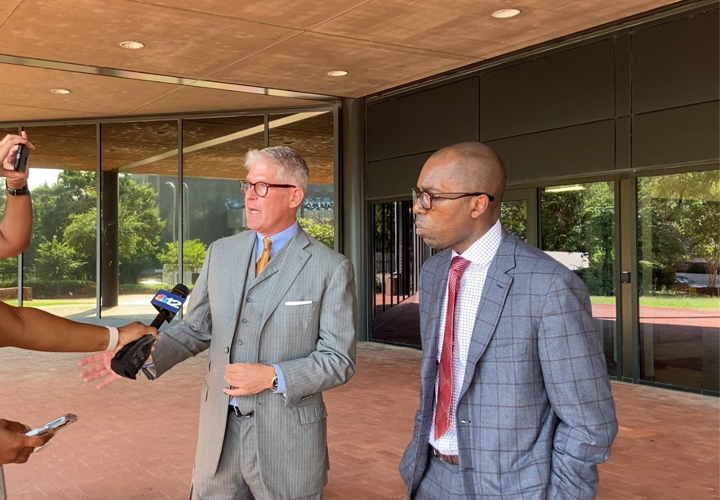
Richmond Circuit Court Judge W. Reilly Marchant denied an effort to retry convicted Huguenot High School graduation shooter Amari Pollard on Friday.
People are also reading…

Pollard

Attorney Jason Anthony, left, is representing Amari Pollard.
From the Archives: A look back at the Richmond region's railroad past

This January 1958 image shows Main Street Station downtown at a time when there was discussion about moving all passenger train traffic to Broad Street Station. Main Street Station, which opened in 1901, ultimately closed in 1975 but reopened in 2003. Future is Questionable for Main St. Station, Built at Turn of Century Seaboard, C & O Study Possible Shift of Passenger Trains to Broad St.

On Dec. 9, 1947, the Freedom Train stopped in Richmond at Allen Avenue and West Broad Street. People waited in blocks-long lines to tour exhibits of historical artifacts that included the original Constitution, Declaration of Independence, Truman Doctrine and Bill of Rights. The Freedom Train, which traveled the country between 1947 and 1949, was the first train to visit each of the 48 states (Alaska and Hawaii had not yet gained statehood).

On May 25, 1946, a train pulled into Main Street Station in Richmond. That afternoon marked the end of a crippling two-day national railroad strike, which had stranded passengers and cargo – local businesses were able to purchase some of the perishable foods as well as tropical fish. President Harry Truman had threatened an Army takeover of railroad facilities if the striking trainmen and engineers unions didn’t return to work.

In May 1978, this train caboose traveling by truck along West Broad Street in Richmond was headed for the old Clover Room restaurant, which new owner John Dankos was remodeling into Stanley Stegmeyer’s Hodgepodge Restaurant. Its eclectic decor was to include two cabooses that would seat 16 diners each.

In June 1970, this Seaboard Coast Line Railroad station at Commerce Street in Petersburg was closed. Three years earlier, the Seaboard Air Line and Atlantic Coast Line railroads merged, and passenger traffic from the Commerce Street location was being consolidated into what had been Atlantic Coast’s North Petersburg station in Ettrick. A dozen trains served the city daily at the time.

In August 1979, the Chesapeake and Ohio Railway was preparing to close the Sabot Depot station in Goochland County. The station hosted its first passenger train in 1881 and its last in 1957; it limped along until 1979 handling odd jobs. CSX dismantled the building in 1993.

In September 1976, the American Freedom Train – touring the country as part of the Bicentennial celebration – stopped in Richmond for an hour on its way to Newport News. It was scheduled to return to Richmond about a week later in early October for its full six-day stay. The steam-powered train included about a dozen cars carrying American history artifacts, including the original Louisiana Purchase, Judy Garland’s dress from “The Wizard of Oz,” George Washington’s copy of the Constitution and Martin Luther King Jr.’s pulpit and robes.

This January 1957 image shows an Atlantic Coast Line Railroad locomotive moving along Washington Street in Petersburg, right next to a car. Tracks along the street were laid during the Civil War, and the railroad received the city’s permission afterward to continue using them. Atlantic Coast removed one track in the mid-1950s but continued to use the other. It has since been removed.

In May 1948, a Seaboard Air Line Railroad diesel-powered passenger train left Main Street Station to head south. The Seaboard’s main line at that time ran from Richmond all the way to Miami. A merger in 1967 renamed the company as the Seaboard Coast Line Railroad, and in 1971, Amtrak took over its passenger operations.

In May 1939, an end was in sight to a six-week strike that included more than 450,000 coal miners and caused a coal shortage that affected many industries. Here, empty coal gondolas stood ready in Richmond yards, awaiting the signal to resume operations. Thousands like these filled train yards in the Appalachian soft coal area.

This June 1946 image shows the train depot at the Army’s Richmond Quartermaster Depot at Bellwood in Chesterfield County. The Army purchased the land from the Bellwood family in 1941 and activated the post the following year. It was heavily used during World War II – more than 800 rail cars would pass through on some days.

In March 1930, the Chesapeake & Ohio Railway’s new luxury train, the Sportsman, stopped at Main Street Station in Richmond on the last leg of an exhibition tour ahead of service beginning on a new route from Norfolk to Detroit and Cleveland. In its day on exhibit in Richmond, the train was visited by about 10,000 people, including Gov. John Pollard, Lt. Gov. James Price, Mayor J. Fulmer Bright and numerous other local and state dignitaries.

This October 1962 image shows the salesmen for the Chesapeake and Ohio Railway posing in front of a train. Wearing derbies, fancy vests while carrying canes, they were responsible for distributing schedules and brochures as well as promoting the comfort and convenience of rail travel to the public.

3/9/1946: Winston Churchill steps from the train at Williamsburg and gives 'ye ole' 'V' for victory sign. Behind him are General Dwight D. Eisenhower, and Mrs. Churchill.

Locomotives are posed on the tracks of the triple railroad crossing in Shockoe Bottom, Richmond, Virginia October 1958.

Triple Crossing in October 1958.