As the Virginia General Assembly session passed this week’s procedural midpoint, some of the Democratic majority’s priorities — such as a proposed ban on assault-style weapons and creation of a legal market to sell marijuana — appear destined for vetoes by Gov. Glenn Youngkin.
People are also reading…

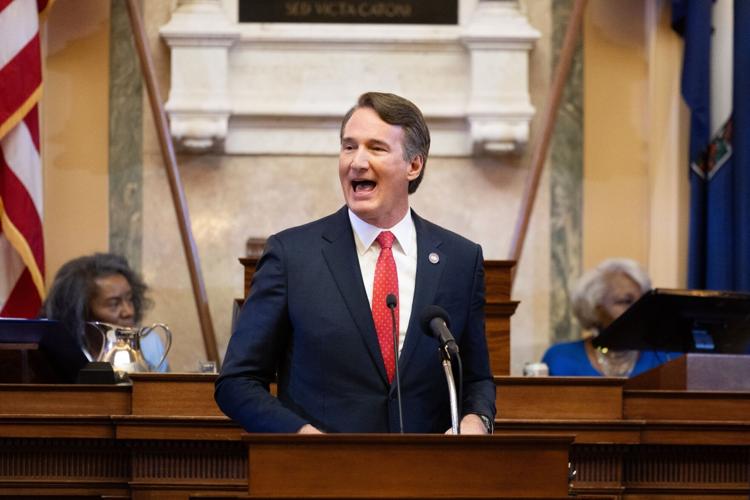
Gov. Glenn Youngkin, seen here delivering the State of the Commonwealth address on Jan. 10, 2024, vetoed more bills in one year than any other modern Virginia governor vetoed in a four-year term.

The Trump administration has revoked visas for at least 25 students at Virginia colleges and universities.

This rendering shows what would have been Phase 1 of the proposed casino project in Petersburg. It’s unclear what a project would look like now, as Petersburg’s resolution to choose The Cordish Companies as the developer has expired.

Richmond restaurant owners gathered at a news conference on Jan. 31 to demand the city make changes to its flawed collection of meals taxes.
Sculptor Sandrine Plante talks about her work which is now on display at the Black History Museum and Cultural Center of Virginia
7 bills to watch in the upcoming Virginia legislative session
Raising minimum wage

The first House of Delegates and Senate bills Democrats filed seek to increase the minimum wage to $13.50 per hour as of Jan. 1, 2025, and to $15 per hour as of Jan. 1, 2026. Currently, minimum wage is $12 per hour in Virginia, and the federal minimum wage is $7.25 per hour — a number that has not changed in over a decade. (Democratic members of Congress have introduced a measure to raise it, but it has yet to progress.)
Mental health support

In perhaps one of the areas that will receive the most bipartisan support, lawmakers want to build on the work they have done to expand resources and services around the state. Gov. Glenn Youngkin’s proposed two-year state budget includes a $500 million boost for behavioral health programs. That figure includes $300 million to clear the waiting list for Medicaid funds to pay for support services for people with developmental disabilities.
Incoming House Speaker Don Scott Jr., D-Portsmouth, recently cited mental health resources as an area in which he expected lawmakers to be able to make bipartisan progress.
Attempts to reverse Clean Car Act

In 2021, Democratic legislators passed a bill to put the brakes on some pollution from tailpipe emissions by hitching Virginia to California’s emissions standards. California is the only state with permission to reach further than the federal standards, so some other states have tethered themselves to California’s.
Some Virginia Republicans are trying again to undo this after unsuccessful attempts in 2023. If passed, the measure would repeal the State Air Pollution Control Board’s authority to implement low-emissions and zero-emissions standards for vehicles with model years of 2025 and later.
Gun laws

Democrats are trying again to pass a proposal to ban future sales of assault-style weapons. If passed, by July 2024, it would be a Class 1 misdemeanor to possess or sell assault-style weapons and high-capacity ammunition feeding devices. The measure cleared the Senate with bipartisan support in 2023 but failed in the GOP-controlled House.
Sen.-elect Schuyler VanValkenburg, D-Henrico, calls proposed gun storage laws “low hanging fruit” that he hopes lawmakers can agree on in the next session. Del.-elect Mike Jones, D-Richmond, is carrying such a bill.
In late December, VanValkenburg and Del. Rodney Willett, D-Henrico, also introduced a bill under which gun owners who allow minors to use them could be guilty of a Class 1 misdemeanor. The bill elevates penalties to a Class 5 felony if gun owners know “or reasonably should know” that a minor possessing their weapon has previously been charged with a violent crime or has been subject of school threat assessments deemed moderate, high or imminent.
Republican Del.-elect Tom Garrett, who will represent a district that extends from Goochland and Fluvanna south to Appomattox, has introduced a bill to allow conceal-carry permit holders to bring their firearms onto state property. If passed, this would undo a law Democrats passed in 2021, when they controlled both chambers and held the governorship, that prohibits firearms on most state properties.
Rights restoration

Democrats put forth a proposed constitutional amendment that would make restoration of rights constitutionally guaranteed for felons who have completed their sentences. For constitutional amendments to be enacted, a resolution must pass two years in a row with an election for the House in between. That means this amendment could appear on ballots to voters statewide as early as 2026.
Sen. Mamie Locke, D-Hampton, who is carrying the Senate resolution this year, has carried it several times before — but Democrats now control both legislative chambers.
Virginia’s constitution strips people convicted of felonies from several rights, to include voting, unless a governor restores their rights.
Reproductive rights

Since the U.S. Supreme Court overturned federal abortion protections, each state now decides on measures regarding access and proposed restrictions. With Virginia the last Southern state without a ban or significant restrictions, the issue surfaced as a prominent campaign issue in this year’s elections for the General Assembly. Since Democrats retained control of the Senate and flipped the House, Republican lawmakers are unlikely to pass the proposal Youngkin backed to bar most abortions after 15 weeks with exceptions for rape, incest and the life of the pregnant person.
In 2024, Democrats will attempt to enshrine protections into the state’s constitution. As with the restoration of rights resolution, this process could take years.
Sen. Barbara Favola, D-Arlington, will propose a measure to prohibit the use of search warrants to obtain menstrual health data, and one to prevent someone who travels from out of state to receive an abortion in Virginia from being extradited. While both bills were unsuccessful in 2023, they could advance through both chambers now that they are under Democrats' control. Youngkin could then veto, seek to amend or sign the measures.