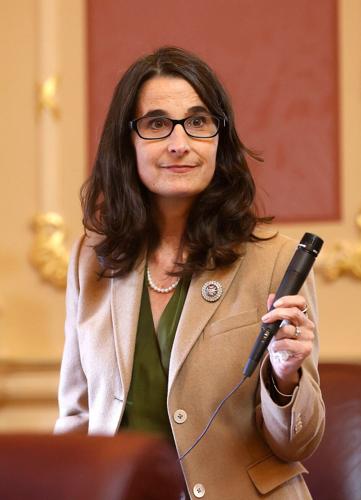
After seven years of trying, legislators pushing for a program that would cover some employee earnings if they have to stay away from work to care for a family member have finally gotten a bill through the General Assembly.
People are also reading…

Ives

Boysko
From the Archives: Old Richmond buildings

This July 1955 image shows the building, at Madison and Grace streets in Richmond, that once sat downtown and housed First Presbyterian Church. Completed in 1853 at the current site of Old City Hall, the building’s outer shell was moved to Madison and Grace in the mid-1880s to make room for the city building. In 1943, the Acca Shriners, who had lost the Mosque (now Altria Theater) during the Great Depression, purchased the old church building. They used it until the mid-1950s; the building has since been torn down.

In May 1977, this 150-foot smokestack came down, thanks to Controlled Demolition of Towson, Md. The smokestack stood behind what used to be Broad Street Station in Richmond; the demolition was part of a contract with the state for removal of the stack and several buildings in the area.

This April 1951 image shows St. Andrew’s School in Richmond’s Oregon Hill area. Noted philanthropist Grace Arents founded the school in 1894 and was a key supporter of St. Andrew's Episcopal Church. The school offered a wide range of programs, including sewing, music and physical education. It still stands today, serving low-income children.

In May 1959, the Chesapeake and Ohio Railway announced plans to move about a third of its workforce from Richmond to Huntington, W.Va., by 1961-62. Many employees worked in the First and Merchants National Bank building at Ninth Street downtown, which was partially owned by C&O. The building has been converted to First National Apartments.

This July 1947 image shows the new Curles Neck Dairy plant at 1600 Roseneath Road in Richmond. The building, which cost more than $200,000, gave the 13-year-old dairy modern features including a refreshment room that served up to 50 people, ice-cream-making facilities and curbside service. The building is now home to the Dairy Bar restaurant.

This March 1987 image shows the Independent Order of St. Luke building at 900 St. James St. in Richmond, which was the new home for the city’s Head Start program. The building, which today stands empty, was built in the early 1900s and was expanded between 1915 and 1920. It was home to the benevolent society under Maggie Walker’s leadership, as well as the first location of the St. Luke Penny Savings Bank that she ran. The building is on the National Register of Historic Places.

This May 1935 image shows Herbert’s shoe store at 419 E. Broad St. in downtown Richmond. The store advertised itself as “the first air-cooled shoe store in the entire South.” A fall sale that year offered women’s shoes as low as $1.77.

In February 1968, the National Theater on East Broad Street in Richmond was about to undergo a $150,000 remodeling to make it suitable as a movie theater – the building, which opened in 1923, was designed more for vaudeville and other live performances. In June 1968, the theater reopened as The Towne and operated until 1983. It has since been restored again and now hosts concerts.