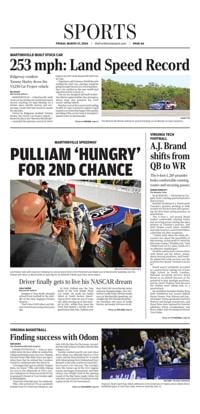


The Martinsville Missile making its record-breaking run on Monday at Cape Canaveral.
The Martinsville Missile making its record-breaking run on Monday at Cape Canaveral.
The Martinsville Missile making its record-breaking run on Monday at Cape Canaveral.
The Martinsville Missile making its record-breaking run on Monday at Cape Canaveral.
One of NASCAR’s oldest and most storied venues could again be at risk of losing major race dates, a concern driving the creation of a new Virginia Motorsports Caucus aimed at preserving the sport’s future across the state.
State Sen. Bill Stanley, R-Franklin County, said Martinsville Speedway — a cornerstone of NASCAR since 1949 — has already come close to losing a premier Cup Series race in recent years, underscoring the fragile position even the most historic tracks now face.
“Standing together, we cannot lose,” Stanley said in announcing the caucus, which launched during the final week of the 2026 General Assembly session.
The bipartisan group brings together lawmakers, NASCAR officials, racetrack operators, and tourism leaders to address mounting challenges confronting motorsports in Virginia — and to prevent further erosion of a sport deeply tied to the region’s identity.
Few tracks embody that legacy more than Martinsville Speedway. Known for its paperclip-shaped layout, tight turns, and distinctive grandfather clock trophy awarded to winners, the half-mile track is the oldest venue on the NASCAR Cup Series schedule. It has hosted races every year since the sport’s early days, becoming a proving ground for generations of drivers.
But history alone has not insulated Martinsville from modern pressures.
In 2021, NASCAR temporarily reduced the track’s Cup Series presence from two races to one, a move that sparked concern among fans and local officials before the speedway ultimately regained a second date. That episode remains a cautionary example of how quickly scheduling decisions — driven by national business considerations — can reshape the sport’s footprint.
Now, Stanley and other leaders warn similar risks remain.
Across Virginia and the country, short tracks are grappling with declining sponsorships, rising costs, and shifting audience habits as more fans watch races from home. Encroaching residential development has also brought noise complaints and legal challenges that threaten long-standing venues.
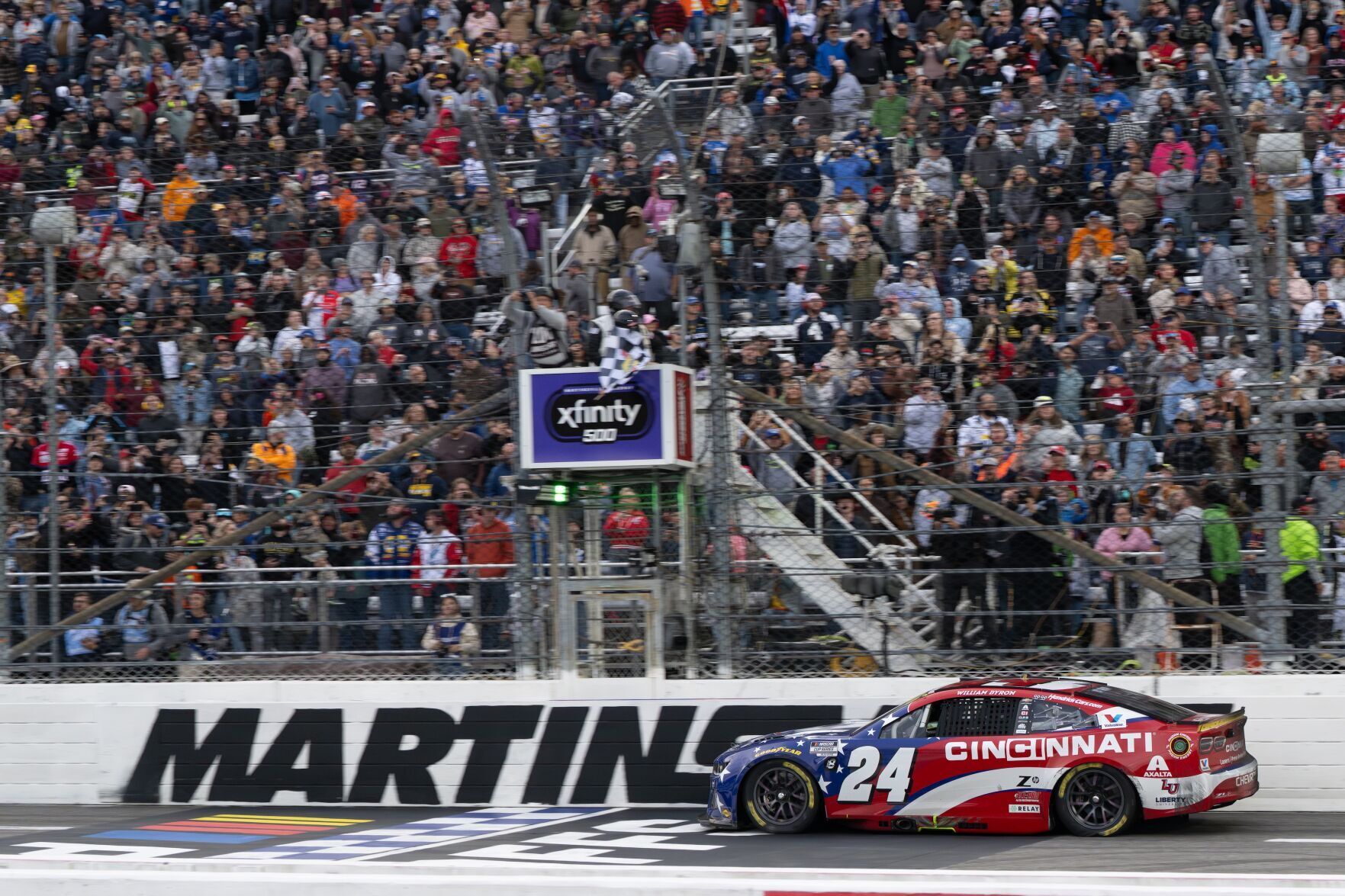
William Byron crosses the finish the win the NASCAR Cup Series Xfinity 500 last October at Martinsville Speedway.
Those pressures are not unique to Martinsville but are especially consequential given its outsized role in the region’s economy and culture.
A national study cited at the caucus meeting found that motorsports generates more than $900 million annually for Virginia and supports more than 5,000 jobs. Race weekends in Martinsville draw tens of thousands of visitors, filling hotels and restaurants and providing a significant boost to local businesses.
State leaders say protecting that economic engine will require a more coordinated effort.
Among the ideas discussed by the caucus are so-called “right-to-race” laws that would shield tracks from nuisance lawsuits if they predate nearby residential development, as well as potential state investment in facilities and marketing.
An economic impact study, estimated to cost about $75,000, is also being considered to better quantify motorsports’ value and strengthen the case for public support.
The push comes as other states aggressively invest in racing.
North Carolina has directed tens of millions of dollars toward motorsports-related projects in recent years, while states like Delaware and Pennsylvania have provided funding and sponsorship support to keep race venues competitive and attractive to NASCAR.
Virginia leaders worry that without similar efforts, the state could fall behind — and that even iconic tracks like Martinsville could lose ground.
The concerns extend beyond the Cup Series.
Short tracks have long served as the pipeline for developing drivers and sustaining grassroots interest in racing. The prolonged closure of venues like Southside Speedway in Chesterfield County — shuttered since 2020 but now the subject of revival efforts — highlights the vulnerability of that ecosystem.
Stanley said preserving both major venues and smaller tracks is essential to maintaining the sport’s future.
“Virginia gave NASCAR some of its earliest speedways and some of its greatest history,” he said. “We have to make sure it has a future here as well.”
For Martinsville, that future remains closely tied to NASCAR’s evolving schedule and the broader economics of the sport.
While the speedway continues to host two Cup Series races, including a key playoff event each fall, officials acknowledge that nothing is guaranteed in an era of shifting markets and increasing competition among venues.
Martinsville Speedway president Clay Campbell talks to a group of reporters and drivers during a media day ahead of the ValleyStar Credit Union 300 in 2025, marking the 30th anniversary of the race.
Martinsville Speedway President Clay Campbell has historically pushed back on speculation about losing race dates, previously calling such concerns “unfounded” while emphasizing the track’s strong fan support and deep roots in the sport. At the same time, he has acknowledged NASCAR’s evolving landscape and the need for tracks to continue improving facilities and the fan experience to remain competitive.
That tension — between tradition and change — is now at the center of the state’s renewed focus on motorsports.
The newly formed caucus plans to continue meeting over the coming months, with Stanley saying he hopes to develop a legislative package ahead of next year’s General Assembly session.
For now, the message from state leaders is clear: preserving Martinsville Speedway is not just about protecting a racetrack, but about safeguarding a piece of Virginia’s heritage — and ensuring it remains part of NASCAR’s future.

Austin Beers celebrates winning the NASCAR Whelen Modified Tour championship at Martinsville Speedway on Oct. 23, 2025.
Gov. Abigail Spanberger casts her ballot on the redistricting referendum in Richmond on Friday, March 20, 2026.
RICHMOND — Former Gov. Glenn Youngkin’s purging of voting rolls in the weeks before the 2024 presidential election would be barred under a new executive order from Gov. Abigail Spanberger.
The order replaces two earlier Youngkin orders.
It says any program to remove names from voting rolls must be completed 90 days before a federal election, and the order reiterates several long-standing election security measures.
Efforts in the General Assembly to say the same, House Bill 28 and Senate Bill 52, never made it out of the legislature this year.
"With even more days of voting on our calendar this year, I’m acting early to strengthen Virginia’s transparent, robust voting process and protect the rights of all eligible Virginia vote,” Spanberger said.
Spanberger’s order also reverses Youngkin’s move to pull Virginia out of the nonprofit, nonpartisan Electronic Registration Information Center, a 26-state program that shares information about voters who move from state to state or within a state, as well as duplicate registration and the names of voters who have died.
Virginia was one of the founders of the center in 2012.
“When Virginia withdrew from ERIC in May 2023, it became more difficult for Virginia’s election administrators to obtain information to help maintain Virginia’s voter rolls and otherwise engage in routine voter list maintenance,” such as identifying voters who moved out of state, Spanberger said.
“Rejoining ERIC will provide Virginia election administrators with access to more accurate information, improving election integrity in Virginia,” she said.
A Youngkin order in August 2024 directed elections officials to make daily removals of voter names based on Department of Motor Vehicles reports about the citizenship status of drivers.
The effort cut some 1,600 voters from the rolls, including U.S. citizens who had not bothered to tell DMV that they had become naturalized citizens since first applying for a driver’s license.
At the time, the U.S. Department of Justice asked federal courts to block a 1993 federal law’s so-called "Quiet Period Provision" that says states must complete any systematic effort to remove the names of ineligible voters from voter registration lists no later than 90 days before federal elections.
The department said systematic removal programs may be error-ridden, cause voter confusion and remove eligible voters days or weeks before Election Day who may be unable to correct a state's errors in time to vote or may be dissuaded from voting.
But the U.S. Supreme Court overturned lower court directives to restore purged voters to the rolls.
In Richmond, Eric Terrell only found out he’d been dropped from the city’s voter rolls when he asked for an absentee ballot for the 2024 presidential election. He thought he may have checked the wrong box when he applied for a DMV ID card.
Christine Rabassa, another lifelong citizen dropped from the Henrico County rolls, said she learned the reason was because she had not checked the box declaring she is a U.S. citizen when she got a new license in August.
Spanberger’s order also reiterates existing ballot security requirements, including that there must be a documented chain of custody for paper ballots to track ballots through every step of the process and that the number of ballots cast matches the number of voters checked in to vote.
The order also reiterates long-standing requirements that only paper ballot-counting machines be used and that no ballot-counting machines be connected to the internet.
Dave Ress (804) 649-6948

Ram’s sports investment; Dr. Winn moves onto Philadelphia; Cannabis laws may change

Read the stories from the Richmond Times-Dispatch's three-day series on data centers and the key issues they pose.
Franklin County Board of Supervisors members Lorie Smith (from left), Nick Mitchell and Marshall Jamison discuss the county budget at a work session held Tuesday.
Supervisors in Franklin County are considering increasing the real estate tax rate up to 7 cents as they look for ways to balance the budget in the upcoming fiscal year.
The vote was nearly unanimous in favor of advertising the 7-cent increase as well as a 2-percentage-point increase in the county's meals tax. The rates could be reduced by supervisors at the public hearing scheduled in three weeks.
The proposal would increase the real estate tax rate from 43 cents to 50 cents per $100 of assessed value. The meals tax would increase from 4% to 6%.
Supervisors listed several ongoing needs in the county, specifically in public safety and schools, as they settled on advertising the increases. Boone District representative Mike Meredith was the lone vote against the proposal, stating the increases didn't go far enough.
Franklin County Public Schools presented a budget proposal last week that included $8.9 million in additional funding for the upcoming fiscal year. Union Hall District representative Dan Quinn was in favor of providing the school system with some additional funding.
"They can't operate an organization at this level if we keep them underfunded," Quinn said.
Blackwater District representative Marshall Jamison asked why the schools budget has been increasing in recent years as the number of students enrolled continues to drop. He pointed to the school system's dwindling average daily membership data that the state uses in providing funding for localities.
"The ADM is going down, but the budget is going up," Jamison said.
To curb the county's growing cost of purchasing equipment and vehicles, Meredith and other supervisors suggested 1 cent from the proposed tax increase be dedicated to public safety. The county has a rotation of purchasing fire trucks and other equipment for volunteer fire departments each year that cost the county close to $1 million annually.
In addition to increasing the real estate and meals tax, Quinn suggested lowering the county's personal property tax currently set at $2.41. He said the tax unfairly impacts the county's poorer residents and should be lowered as the real estate tax is raised.
"I think it would shift a little bit of the burden from the poor people in the county to the wealthy people," Quinn said.
Following the discussion, Gills Creek representative and Chairperson Lorie Smith thanked supervisors for their willingness to consider taking on some of the challenges the county is facing. She said needs in the county had gone underfunded for years.
"You all are demonstrating courage," Smith said. "You all are demonstrating a willingness to accept the reality of where we are in order to be able to maintain services for our citizens — especially the big-ticket items in public safety, the sheriff's office and schools."
A public hearing on the advertised tax rates will be held Tuesday, April 14 at 6 p.m. in the Franklin County Government Center.
Jason Dunovant (540) 981-3507
A Rocky Mount man was charged Thursday in the death of his younger brother, who was reported missing about a month ago.
Hodges
On March 17, the Franklin County Sheriff’s Office discovered a body in the area of Power Dam Road. The remains were transported to the Medical Examiner’s Office, where they were identified Wednesday as those of Charles Arthur Smith Jr.
Smith, 21, was reported missing after being last seen or heard from on about Feb. 22, according to the sheriff’s office.
An autopsy determined his death was a homicide.
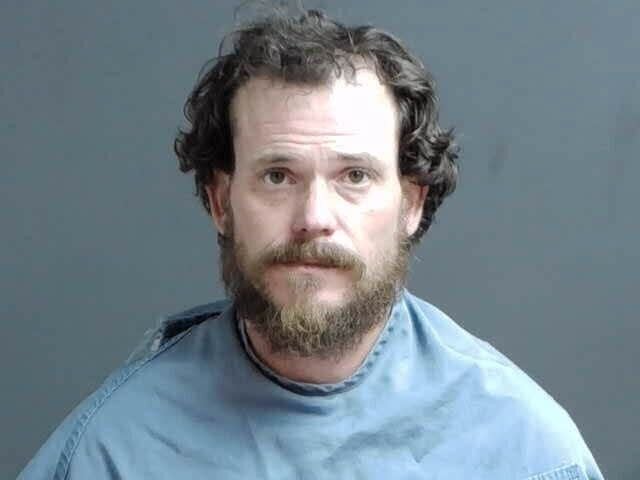
Early Thursday, authorities arrested Terry Shawn Hodges, 43, on a charge of second-degree murder.
Hodges was being held without bond in the Western Virginia Regional Jail.
Laurence Hammack (540) 981-3239