

Virginia Tech student expelled for sexual abuse settles lawsuit against school
A former member of Virginia Tech's Corps of Cadets who was kicked out of school for sexually abusing two female students has settled a lawsuit that claimed the university's disciplinary system was stacked against him.
The case was dismissed Monday after both sides "resolved this matter upon mutually agreeable terms" during a confidential mediation session held in June, according to court records.
U.S. District Judge Thomas Cullen had earlier denied a request by Tech to dismiss the lawsuit, saying it raised "grave concerns" about the school's Title IX program.
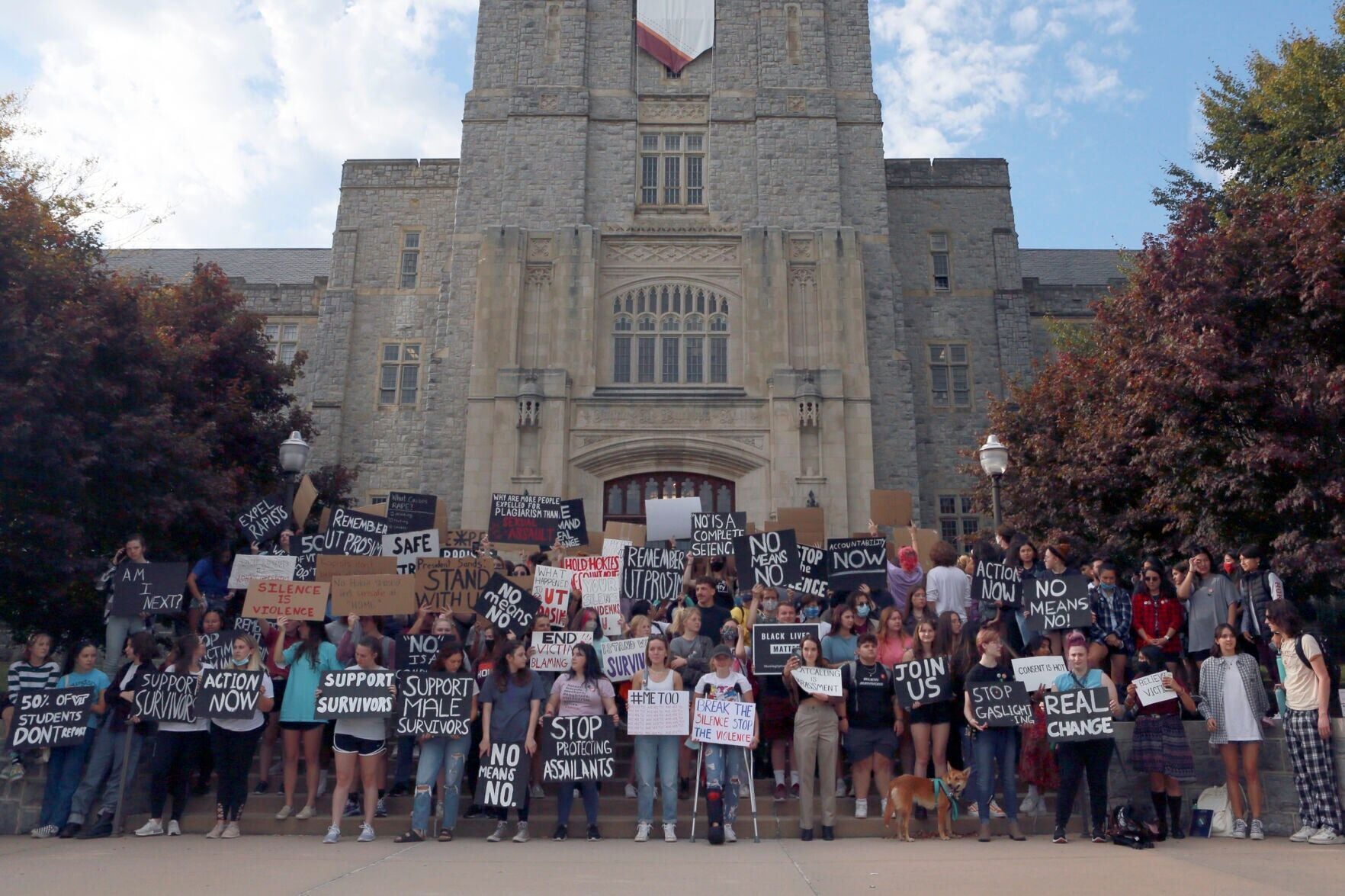
More than 200 gathered on the front steps of Burruss Hall at Virginia Tech in 2021 to protest acts of sexual violence. Those in attendance criticized the practice of current Title IX policies and demanded more sweeping systemic changes.
Identified in court records only as John Doe, the former student contended that he was a victim of a deep-seated bias against males who are investigated in proceedings governed by a civil rights law that prohibits discrimination, harassment or sexual assault against students at colleges and universities that receive federal funding.
In a May 21 opinion, Cullen wrote that Doe had alleged "abundant facts" that — if true — raised a plausible inference that Tech "discriminated against him in these investigations because he is male, and, in so doing, violated Title IX."
The lawsuit is one of many across the country, most of them brought by male students accused of sexual misconduct, that challenge the system's fairness.
"Depending on how cases are counted, public litigation trackers and advocacy organizations estimate that more than 800 lawsuits have been filed nationwide over the past decade and a half," Thomas Terrill, director of the National Education Defense Practice Group of the LLF National Law Firm, wrote in an email. Terrill's law firm was not involved in the lawsuit against Tech.
There have been at least 274 settlements, Terrill said. Cases are often settled after rulings such as the one made by Cullen.
Terms of the settlement reached Monday were not disclosed. A Virginia Tech spokesman, who earlier said the university does not comment on matters of pending litigation, could not be reached Monday.
Lindsay McKasson, an Alexandria attorney who represented Doe, said only that the matter has been resolved to the parties' mutual satisfaction.
"A settlement should not be interpreted by itself as an admission of wrongdoing by either party," Terrill said.
Doe had asked for an injunction ordering Tech officials to remove any reference to the two cases from his student record. He also sought $20 million in compensatory and punitive damages.
What allegedly happened
In October 2023, a student reported, first to the Blacksburg Police Department and later to the school's Title IX office, that Doe had sexually assaulted her during a "date night" at her off-campus apartment, according to records in Roanoke's federal court.
The two had earlier engaged in consensual sexual encounters. But on the night in question, the student alleged that Doe brandished a switchblade knife and violently assaulted her in her bedroom for an hour and a half.
At a Title IX hearing in May 2024, Doe was found responsible for violating the Student Code of Conduct for sexual assault, abusive conduct and dating violence. He was suspended for two years.
Later that year, a hearing was held on a second allegation against Doe, this one made by a female cadet who said he abused her in a dorm room after a night of heavy drinking by both.
Although she had no memory of the encounter, the cadet alleged it amounted to sexual assault because she was incapacitated. Hearing officers concluded that it was "more likely than not" that Doe had sexually assaulted both students.
He was then expelled from Tech.
Doe's vehement denials and attempts to present evidence that he claimed undermined his accusers' accounts were given "short shrift" by Tech officials, Cullen wrote in recounting the lawsuit's allegations.
In the first case, the victim later conceded that she was never threatened with a knife, according to the filing, and parts of her account were refuted by her roommate. The Montgomery County commonwealth's attorney declined to bring charges in the case, citing questions about the witness's credibility, Doe's lawsuit stated.
Regarding the second woman's claims, Doe asserted that she waited more than five weeks before filing a Title IX complaint — and did so only to receive immunity from a disciplinary charge of underage drinking the night of the alleged assault.
Cullen's decision not to dismiss the lawsuit came at an early stage of the proceedings, when the allegations are presumed to be true for the purpose of determining whether it states a valid legal claim.
Some of the allegations did not pass that test. But the judge allowed five counts that go to the heart of the case to proceed to discovery, a process that allows the parties to collect additional information.
Several weeks later, the case went into mediation.
How the system works
Title IX proceedings generally are similar to court cases, although the standards of proof are lower and the rules of evidence less stringent.
When students are found responsible of wrongdoing, sanctions can include a formal warning, probation, suspension or expulsion.
Advocates say the system is needed to maintain campus safety, hold offenders accountable and provide victims with an alternative to bringing criminal charges, which many are reluctant to do in sexual assault cases.
In 2021, student protests called on Tech to take a more active role in its handling of sexual assaults on campus.
Tech says it is committed to the process. "Every member of our community has the right to live in an atmosphere free from sexual harassment and violence," reads a page on the school's website that provides advice and resources to victims.
When he first filed his lawsuit, Doe was allowed to sue using a pseudonym. His attorneys argued that even if he prevailed at trial, Doe's reputation would be forever harmed if his name appeared in public records.
U.S. Magistrate Judge Kailani Memmer, who presided over the mediation session, agreed to seal 10 of the exhibits to his lawsuit, including Tech's investigation report and the transcripts of the two hearings.
Doe's name — and those of his accusers — appeared in the records that were sealed, Memmer wrote. The public's right to access judicial records was not harmed, she held, because the other facts of the case remain available in open court records.
Laurence Hammack (540) 981-3239