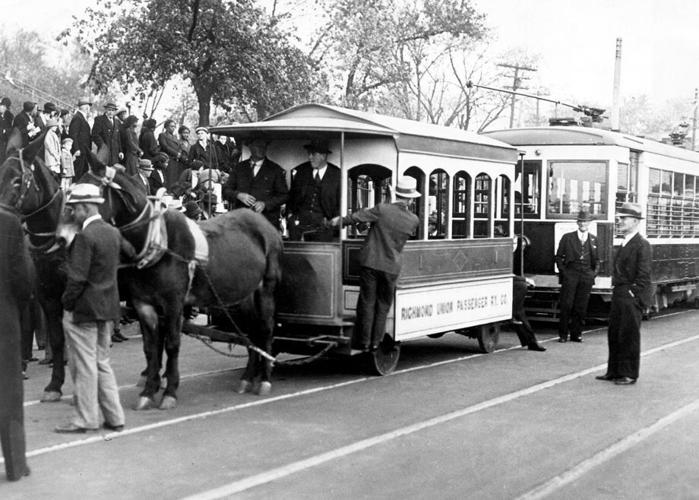

In November 1934, a reproduction of a mule-drawn trolley was the first vehicle to cross the newly restored Marshall Street Viaduct in Richmond. Horse- or mule-drawn trolleys were a preferred mode of transportation here starting in about 1860. They began to be replaced by electric trolleys in the late 1880s, and they were all retired by 1901.
People are also reading…

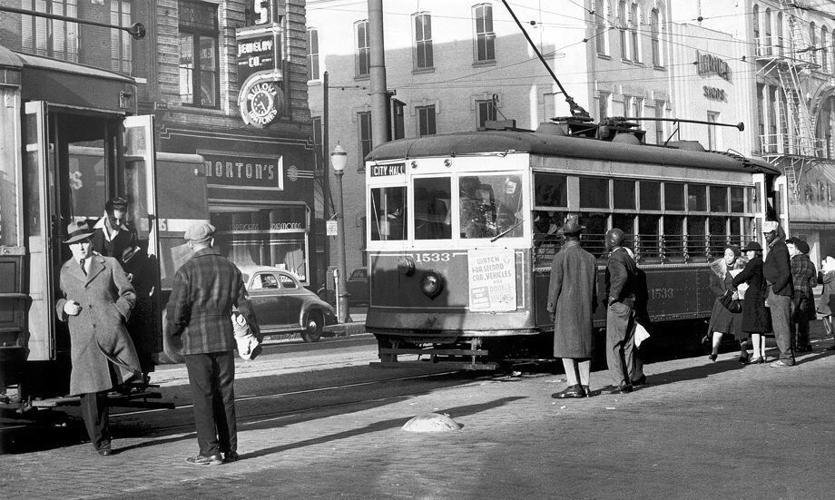
This February 1946 image shows Richmond streetcars double-berthing at First and Broad streets downtown. Loading and unloading streetcars simultaneously at the same stop helped speed transit service, according to Virginia Transit Co. officials.
Gallery: Remembering Richmond's trolley past
Trolley at Forest Hill Park

Trolley at Forest Hill Park, circa 1910. Standing at left of the trolley in the dark suit is Richmond businessman T. J. Cousins. In 1889, the property that would become Forest Hill Park was sold to the Southside Land and Improvement Company, and became a terminus for the Forest Hill trolley, part of one of the first successful trolley systems in the United States. To attract passengers to the countryside, the residence on the property was converted into a trolley terminus and an elaborate amusement park was built on the grounds, complete with carousel, roller coaster, fun house, dance hall, penny arcade, and golf course. The park also included a bath house, swimming area, and boat lake. The park remained a popular Richmond attraction until it closed in 1932 due to the economic constraints of the Great Depression.
Trolley tracks

Laying trolley tracks at First and Broad Streets, circa 1897.
Trolley on Seventh Street

Trolley on Seventh Street between Franklin and Grace Streets, circa 1895.
Richmond streetcars

In January 1945, Alma May Billings, a 22-year-old streetcar operator for the Virginia Transit Co., modeled one of the new uniforms that had been procured to end a long controversy about what the women should wear. The uniforms were gray with dubonnet trim. Drawn up by stylists for the Virginia Electric and Power Co., the uniforms initially carried a Vepco insignia, but it was soon replaced with a VTC emblem.
Richmond streetcars

In March 1938, the Richmond-Ashland Electric Line ceased operating trolleys after 31 years. The route had its start in 1812 as a stagecoach toll road. Trolleys were seen as the way of the future in 1907, but because of financial difficulties, the route finally changed over to bus service.
Richmond streetcars

In July 1948, Vincent K. Bass said goodbye to “Old 912,” an electric trolley car that had been in service in Richmond for nearly 40 years. Bass, a streetcar conductor for 42 years, was reluctantly learning to drive a bus – the following year, the city introduced a bus system to replace the streetcars. A contractor purchased this streetcar; the owner said he might use some of it for storage or as bunking quarters for some employees.
Richmond streetcars

In November 1934, a reproduction of a mule-drawn trolley was the first vehicle to cross the newly restored Marshall Street Viaduct in Richmond. Horse- or mule-drawn trolleys were a preferred mode of transportation here starting in about 1860. They began to be replaced by electric trolleys in the late 1880s, and they were all retired by 1901.
Richmond streetcars

November 25, 1949. Mayor King presides as the changeover is made on the South Sidle. The last trolley and the first bus are ready to start on their trips to the downtown section suring the ceremony at Hull and Fourty-third Streets. A Virginia Transit Company representative is at right,
Richmond streetcars

November 25, 1949. Charles Phaup, operator of the 408 pulls the trolley for the last time.
trolley

Richmond streetcars

400 block East Broad St. Trolley
ARCHIVE: Richmond Trolley

Trolley No. 408 burns, Dec. 15, 1949.
ARCHIVE: Richmond Trolley

No. 408 of the Richmond trolleys was the last to burn
Richmond streetcars

December 15, 1949. No. 408, The city's last trolley, as it was burned on December 15, 1949.
Trolley

07-20-1967 (cutline): Watching as the last nine-tenths of mile of Richmond streetcar tracks are paved today are (from left) City Manager Edwards; Anthony J. Binga, a member of Community Relations Commission (Biracial Committee); ex-Mayor Claude W. Woodward, co-chairman of the commission; and City Manager-elect Alan F. Kiepper. The tracks, part of an original total of 63.602 miles, will be covered during a two-mile paving project in Richmond's Fulton section. Today's start on the $33,430 paving job was at Louisiana and Main Streets.
Trolley

In September 1982, Sondra Jones, Miss Virginia-USA, helped Phil Reynolds unveiled the name of the trackless trolley – Belle of Richmond – that was set to begin a five-month trial run in downtown Richmond. Reynolds came up with the winning entry in a naming contest. The Belle was replaced by a regular bus the following year.
Trolley

09-23-1982 (cutline): Look, Ma, no cable. The hills gave the car a bit of the San Francisco look, but the Belle of Richmond doesn't run on tracts or electrified lines. The gas-powered trolley, traveling downtown streets and offering seats for 10 cents apiece, does, however, offer a bit of nostalgia. The first city in the country to have electrified trolleys, Richmond got rid of its cars by 1949 and ripped up virtually all of the track to make way for the automobile and bus. Sponsors of the trolley see it as a reminder of the past as well as an effective transport in the inner city.
Trolley

03-05-1982 (cutline): A newly designed, gasoline-powered, trackless trolley was available for free rides yesterday near Grace Street downtown. The Central Richmond Association, a merchants' organization, and other groups are studying the trolley as a possible shuttle vehicle for the future.
Trolley

07-23-1990 (cutline): Mayor Walter T. Kenney breaks a champagne bottle to hearld the beginning of free and expanded trolley service for downtown Richmond.
Richmond-Ashland trolley station

The restored building at 814-816 West Broad Street. The Latin inscription on the top gives the year: 1907. This used to be the Richmond-Ashland trolley station. April 8, 2014.
Richmond-Ashland trolley station

The restored building at 814-816 West Broad Street. The Latin inscription on the top gives the year: 1907. This used to be the Richmond-Ashland trolley station. April 8, 2014.
Ashland-Richmond trolley line

The Trolley Line Trail is a half-mile linear walkway that is part of the historic Ashland-Richmond trolley line. Though the Ashland-Petersburg route hasn't been mapped, the northern portions could follow the path of the old Ashland-Richmond trolley line.