
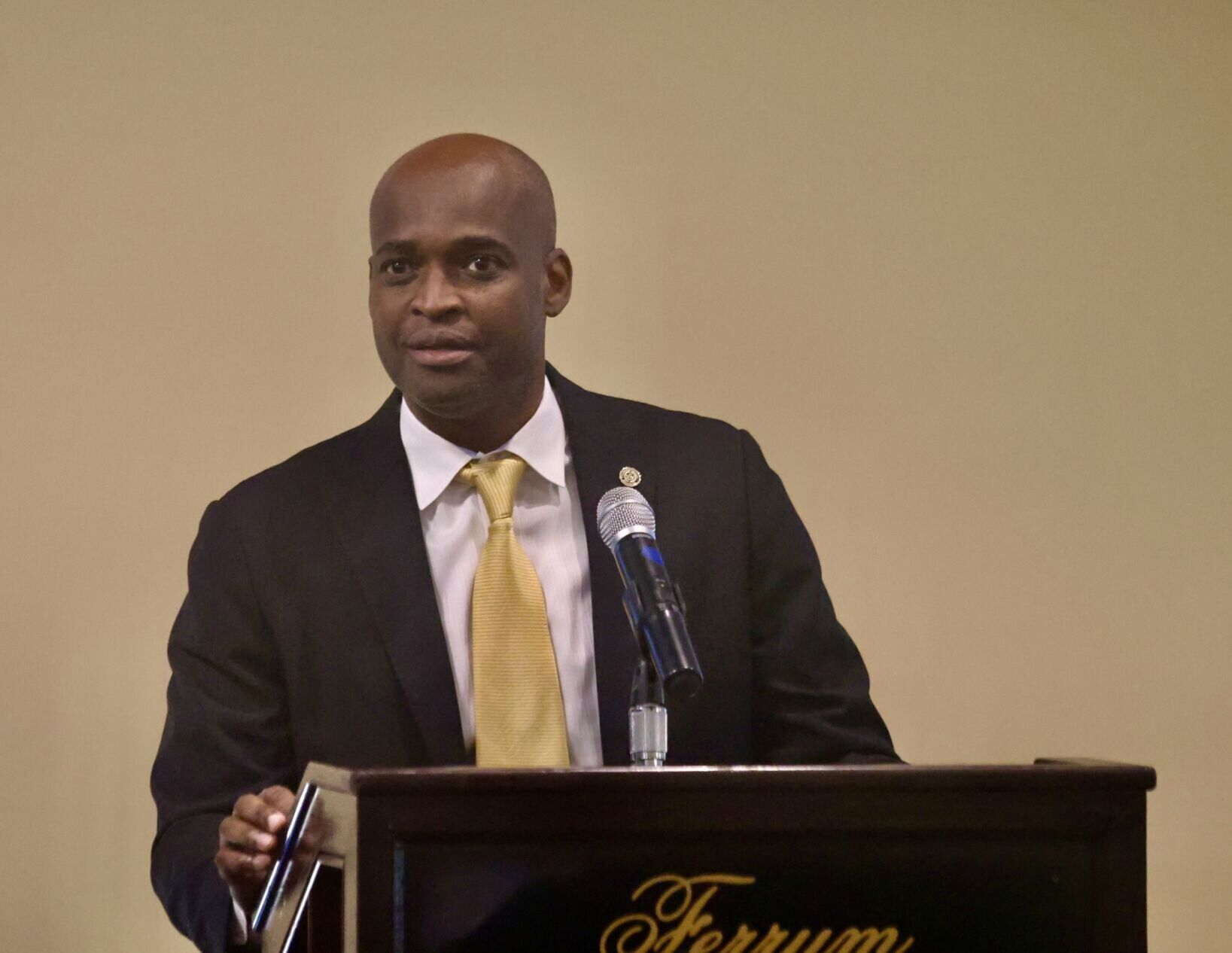
Ferrum graduate and new Ferrum men's basketball coach James Johnson speaks at his introductory press conference Tuesday.
Ferrum graduate and new Ferrum men's basketball coach James Johnson speaks at his introductory press conference Tuesday.
Ferrum graduate and new Ferrum men's basketball coach James Johnson speaks at his introductory press conference Tuesday.
Ferrum graduate and new Ferrum men's basketball coach James Johnson speaks at his introductory press conference Tuesday.
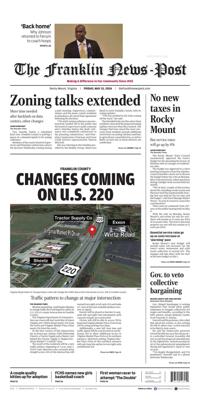
Two months before a scheduled final vote, Franklin County is putting a pause on a planned update to its zoning ordinance.
Members of the county Board of Supervisors and Planning Commission came to the decision Wednesday evening during a joint meeting. Supervisors, commissioners and the many county residents in attendance all voiced their agreement following the decision.
"The draft zoning ordinance was prematurely handed off to the public and the board of supervisors under someone else's timeline before the draft ordinance was completely satisfactory to the planning commission," said Planning Commission Chairman and Snow Creek District representative Sherrie Mitchell.
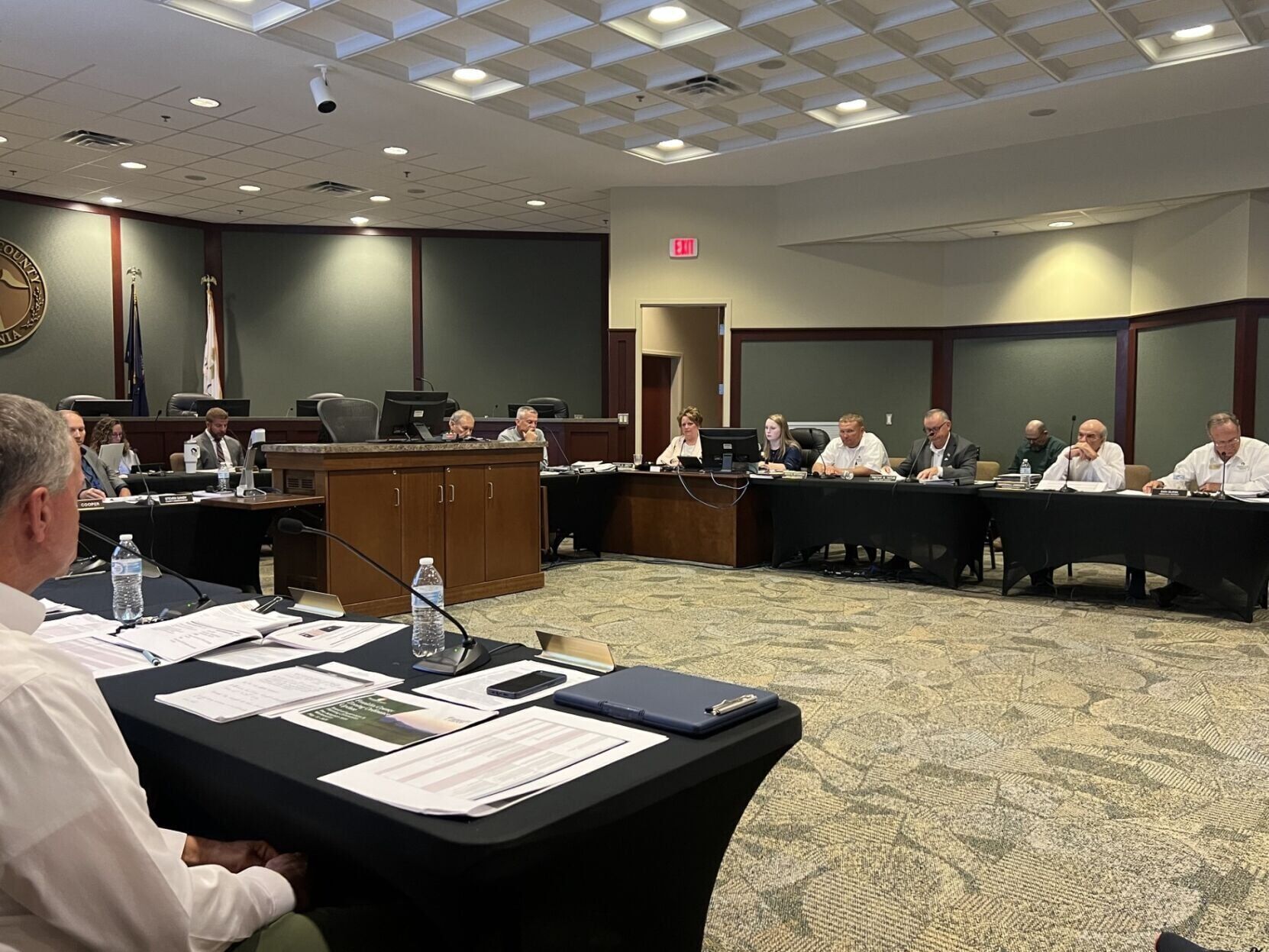
The Franklin County Board of Supervisors and Planning Commission held a joint meeting Wednesday to discuss the current proposed updates to the county's zoning ordinance.
She was referring to the timeline provided by the Berkley Group, which was hired to assist Franklin County with its zoning updates.
"This has resulted in the train coming off the track," she said.
That derailed train was the outcry from residents concerned the proposed zoning updates were not what they wanted. The changes that have raised the most concerns from residents include additional restrictions on raising chickens and bees in agricultural-zoned districts, as well as limits on how lots in those districts are subdivided.
Mitchell asked that the Berkley Group's timeline, which called for an updated zoning ordinance in place by July, be pushed back so a final vote occurs at a later date.
She said the planning commission would take that time to review the zoning changes created by the Berkley Group and the commission during work sessions over the last year, as well as get additional input from county residents and stakeholders on what zoning best fits the county's needs.
Mitchell expressed that there has been little input from the public during the many public work sessions held at the Franklin County Government Center over the last year. She is now "thrilled" that the public has come out to voice their concerns.
"It does not matter where they have been all this time. It does not matter," Mitchell said. "They are here now, and we cannot ignore their right nor their desire to participate."
Planning Commission Vice Chairman and Blackwater District representative David Pendleton agreed that the sudden public interest has been good for the county.
"Honestly, I think it's been healthy," he said.
County supervisors thanked the planning commission for their decision to delay the zoning updates. Each one of the supervisors shared their concerns with the zoning updates as they are currently written.
"What you all want to do, I think is the correct path. To put the brakes on," said Blackwater District representative Mike Meredith.
Blue Ridge District representative Tim Tatum acknowledged recent concerns from residents on a data center possibly coming to the county. He admitted the county currently has no recourse if a data center decides to build in the southern and western areas of the county which are unzoned.
Franklin County is the only county in Virginia that is split with zoned and unzoned areas. The Blue Ridge District is the only district in the county that has no zoned areas whatsoever.
Tatum asked if the county could do something to limit the construction of data centers in the unzoned areas. He suggested a possible county referendum that residents could vote on.
In the county's current zoning, data centers are permitted by right in the areas zoned REP — or Regional Enterprise Park — that includes its business parks. The current zoning offers no standards or protections for the county when it comes to data centers. Some of the proposed zoning updates would look to provide more restrictions that could include requirements for closed-loop cooling systems that would drastically reduce water usage — a major concern.
Snow Creek District representative and Vice Chairman Nick Mitchell agreed with the plan to delay the zoning update, but asked that the planning commission continue to move the project forward. While not suggesting a deadline, he said the county had already spent a lot of time and money on getting the zoning updates to this point.
"I don't want us to be sitting here a year from now and be in the same spot, if not worse," he said.
Jason Dunovant (540) 981-3324
Virginia Department of Transportation crews will change the traffic flow at this intersection on U.S. 220 in Franklin County.
Weather permitting, work begins Monday to change traffic flow and improve safety on U.S. 220 at a major intersection in Franklin County.
The Virginia Department of Transportation says crews will start work May 18 where Virginia 697 (Wirtz Road) meets 220 from the north and Virginia Market Place Drive meets 220 from the south.
At the four corners of this intersection are an Exxon gas station, Faith Fellowship Church, a Tractor Supply and a Sheetz. Just behind the Tractor Supply is Virginia Furniture Market's "Crafted" store.
The result of the roadwork will be a new traffic pattern, beginning at 7 p.m. June 1, VDOT said. Motorists who currently drive straight across 220 at this intersection will instead turn right or left onto 220 and make a U-turn at the next available median crossover or signal.
Barrels will be placed as barriers to separate left and right turn movements until concrete islands are constructed.
Drivers will still be able to access Wirtz Road and Virginia Market Place Drive from 220 by using existing turn lanes.
Additionally, a new left turn lane and traffic signal will be constructed on northbound 220 to allow additional access to Virginia Market Place Drive at its northern entrance. Motorists exiting Virginia Market Place Drive at this northern entrance will only have the option to turn right onto southbound 220.
Lane closures and flagging operations are possible between the hours of 7 p.m. and 6 a.m., VDOT said. Drivers should pay attention to signs and message boards in the area.
Work is expected to be completed by June 30, weather permitting.
These improvements are part of a larger project, VDOT explained, to increase efficiency and create shorter wait times at traffic signals along the 220 corridor in Roanoke, Roanoke County, Franklin County and Henry County.
VDOT says the resulting improvement in operations is similar to widening 220 from four lanes to six lanes, but at a fraction of the cost. Reducing stop-and-go traffic also enhances safety, VDOT added, and crashes may be reduced by approximately 15% to 20%.
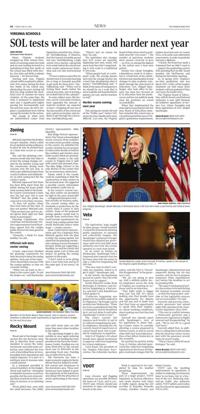
Members of the Rocky Mount Town Council, seen in January. Council members on Monday voted unanimously to approve the town's budget for the next fiscal year.
The Rocky Mount Town Council unanimously approved the town's budget for the upcoming fiscal year on Monday with no changes to residents' tax rates.
The budget was approved in a short meeting lasting less than five minutes. Council members chose not to discuss the budget before the vote on Monday. Most had previously asked questions during a budget work session held last month.
"We've had a couple of discussions about this, including a work session and then last week the required public hearing that was held for the tax rates and the budget," said Town Manager Robert Wood. "So now it is back to council for consideration."
Rocky Mount Town Manager Robert Wood, center, reviews the town's budget with council members during a budget meeting held in April.
There were no comments from citizens at the public hearing held on May 4.
With the vote on Monday, Rocky Mount's real estate tax rate for residents will remain at 13 cents per $100 of assessed value. The town's personal property tax rate will also remain at 51 cents per $100.
Rocky Mount's new budget will include some rate increases for the town's water, wastewater and solid waste collection of around 6%. The changes will take effect with the start of the new budget on July 1.
Wood said at the budget work session the rate increases were due to direction from council members to assure the water, wastewater and solid waste collection rates reflected the true costs of providing those services, including both operational and capital expenses. It is part of a multiyear plan to increase rates a small amount.
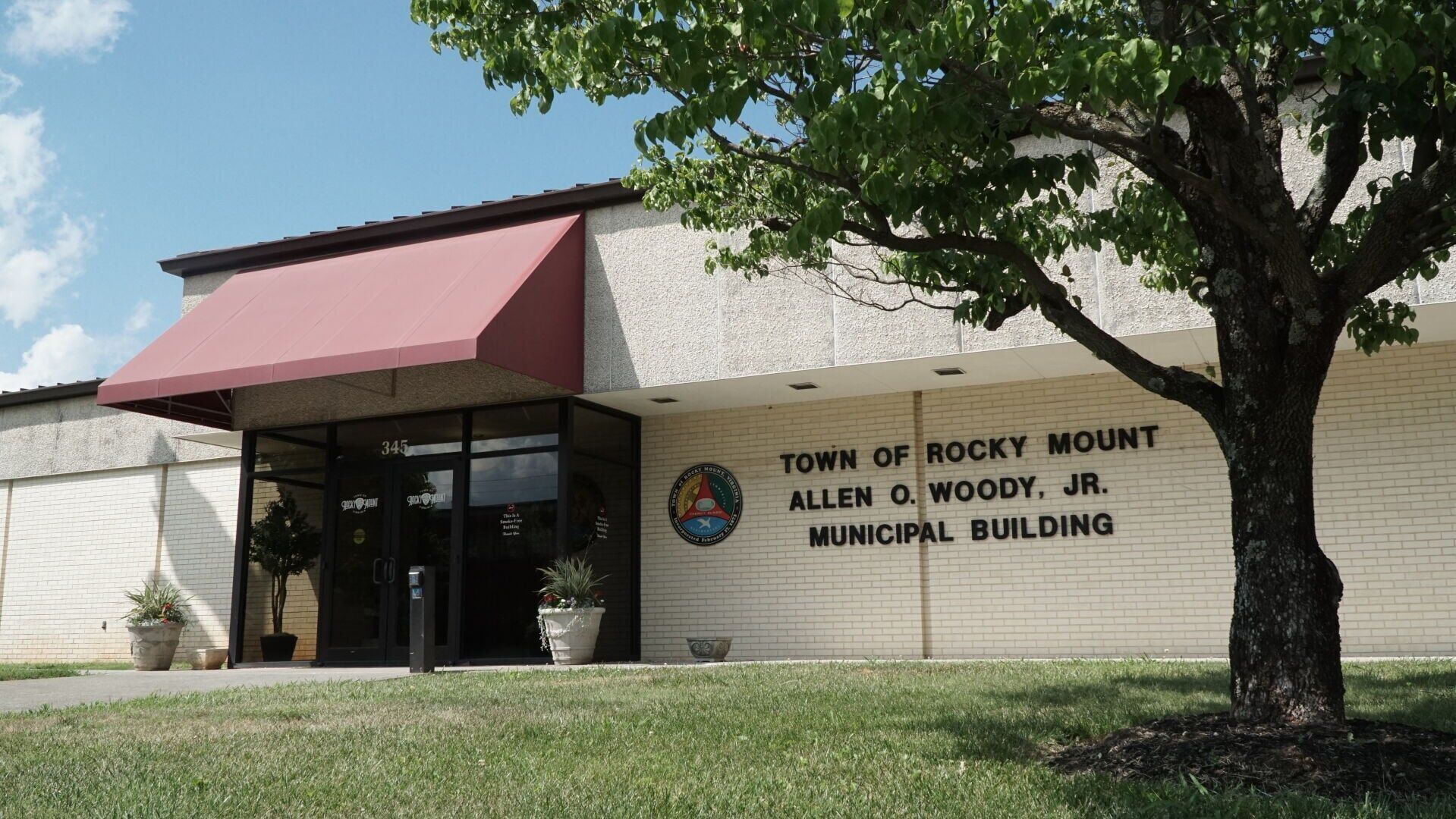
The Rocky Mount Municipal Building, 345 Donald Ave. in Rocky Mount, in 2022.
In a statement provided to council members in the budget, Wood said staff has "attempted to minimize increases as much as possible, but the costs of providing these essential services continue to increase at an alarming rate."
Wood added that, even with the small increases, the utility and solid waste rates are still lower than most other localities in the region.
The upcoming budget is also notable in once again reducing the amount of funding the town provides to the Harvester Performance Center. Funding was cut from $600,000 in the current fiscal year to $550,000 in the upcoming fiscal year. Funding was at $680,000 in 2024.
The Harvester has been a major economic engine for Rocky Mount that has helped to establish several new businesses in the downtown area. Those new businesses have helped to grow the popularity of the downtown area along with the attraction of artists performing at the music venue.
Jason Dunovant (540) 981-3324
Gov. Abigail Spanberger is vetoing legislation that would allow public employees to bargain collectively for wages and benefits, according to the bill's patron, Senate Majority Leader Scott Surovell, D-Fairfax.
Surovell said the governor, who called him about her actions, is also vetoing his bill to allow class-action lawsuits to be filed in state courts.
He said the Democratic governor vetoed the bills because the Democratic-controlled General Assembly did not accept her proposed amendments to the legislation, instead passing by all of the gubernatorial amendments during the legislature’s April 22 veto session.
“I’m deeply disappointed, and I’m perplexed,” Surovell said in a phone interview Wednesday.
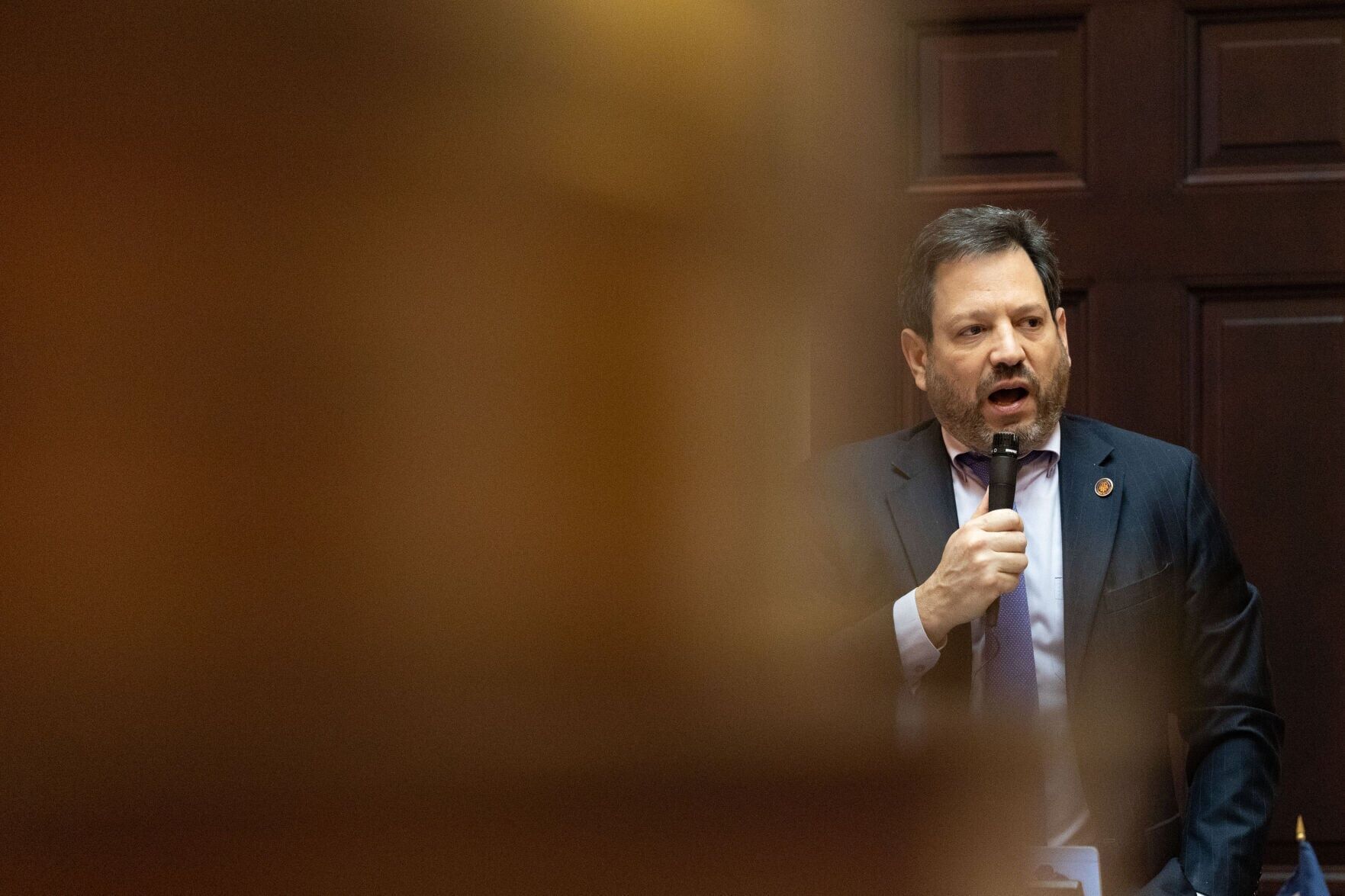
Senate Majority Leader Scott Surovell, D-Fairfax, speaks in the Senate at the Virginia Capitol Building on Feb. 17.
The legislation, long sought by labor groups, would establish a statewide framework allowing public employees to unionize and collectively bargain. But Spanberger’s proposed changes would have delayed key provisions until 2030 and shift more authority over how the system operates to a new state board.
At an event in Fairfax on Wednesday, Spanberger told a Dogwood news reporter that she has been clear that she wants to sign a collective bargaining bill into law.
"But also clear in what I consider my mandate, which is to get it right," Spanberger said.
In the Senate, the legislation passed on a party-line vote with Democrats in support.
Senate Minority Leader Ryan McDougle, R-Hanover, said collective bargaining is a bad policy, and that's why Republicans voted against it.
"Collective bargaining was going to be incredibly expensive to Virginians," McDougle said in an interview Wednesday. "There has to be a commitment that this is a bad policy and we should not do it, not just delay it until after (Spanberger's) term is over."
The state’s current law requires each locality to opt in to collective bargaining for public employees, meaning the city council, board of supervisors or school board must vote to permit its employees to negotiate.
Only 11 of Virginia’s 132 school boards have signed resolutions to approve collective bargaining for school employees.
Carol Bauer, the president of the Virginia Education Association, the statewide teachers union, said the VEA is "incredibly disappointed" in the governor's veto.
"We are not going to give up. Half a million public sector employees across the state of Virginia are counting on us," Bauer said in an interview.
"This fight really is bigger than just one bill. It's about making sure that people have the opportunity for dignity and fair pay and to make sure that they have an opportunity to speak with their employers about working conditions, about making sure that they feel valued."
Surovell was already upset with Spanberger’s veto of his legislation to allow Fairfax County voters to consider allowing a casino proposed in Fairfax County, as well as several other bills that were high priorities of her fellow Democrats in the assembly.
Gov. Abigail Spanberger speaks Monday in Richmond about a bill that will create a paid family and medical leave program.
He said that he and Del. Kathy Tran, D-Fairfax, who had sponsored the collective bargaining legislation in the House of Delegates, had made changes that the Spanberger administration had requested during the 60-day session, only for her to propose numerous other amendments just before the deadline to act on pending bills.
“We expect fundamental policy discussions to be held during the General Assembly session … so that the typical give-and-take of the legislative process can occur in public,” he said.
Surovell said previous Democratic governors had vetoed eight bills introduced by Democratic legislators since 2001.
“This sort of conflict between a Democratic governor and a Democratic legislature is highly unusual and disappointing,” he said. “We’re not off to a good start here.”
Surovell added that, in addition to calling him to inform him directly about her vetoes, he has met with the governor several times in recent weeks.
“There’s been a little bit more dialogue,” he said.
Anna Bryson (804) 649-6922

Big Dipper Innovation Summit Day 2; RTD 100 restaurants; Free Press building sold