

ACC's Phillips unveils new tiebreaker policy for football
CHARLOTTE, N.C. — Deciphering the ACC’s complex tiebreaker policy to determine who Virginia was going to play in last season’s league football championship game left many fans and pundits recreating a popular scene from the 10th season of “It’s Always Sunny in Philadelphia.” You know, the one where Charlie fills up an entire wall with paperwork trying to point to a conspiracy.
The league ended up going to the fifth of six tiebreaker elements to determine that five-loss Duke gained the edge over Miami, Georgia Tech, SMU and Pittsburgh. It was a process that left many people confused and opened the door to implementing a change.
ACC commissioner Jim Phillips unveiled the league’s updated tiebreaker policy during his annual forum on Wednesday to open the league football media days. It’s a three-step process that focuses on head-to-head matchups and moves analytics into a more important role.
The goal of updating the tiebreaker policy, according to Phillips, is to ensure the two best teams are playing in the ACC championship game that is scheduled for noon on Dec. 5 at Bank of America Stadium. Having the title game be a showcase of the league’s best is imperative with the College Football Playoff changing its automatic qualifiers to the conference championship game winners from the Power Four conferences (ACC, Big Ten, Big 12 and the SEC) and the highest ranked Group of Six conference champion.
“You have to do everything you can to position your championship game with those two best teams,” Phillips said.
The tiebreaker policy was implemented after Phillips said the league evaluated more than 10,000 simulated seasons to determine different scenarios that could play out.
The ACC likely couldn’t have envisioned a scenario playing out that unfolded last season. Duke, Miami, Georgia Tech, SMU and Pittsburgh finished with 6-2 league records, did not play a complete round-robin among the group and defeated the lone common opponent (Syracuse). That meant the tiebreaker was determined by the combined conference winning percentage of each team’s league opponents.
Head-to-head matchups remain the first tiebreaker. With the league entering its third season with 17 teams, there are fewer opportunities for the heavyweights to play on a yearly basis.
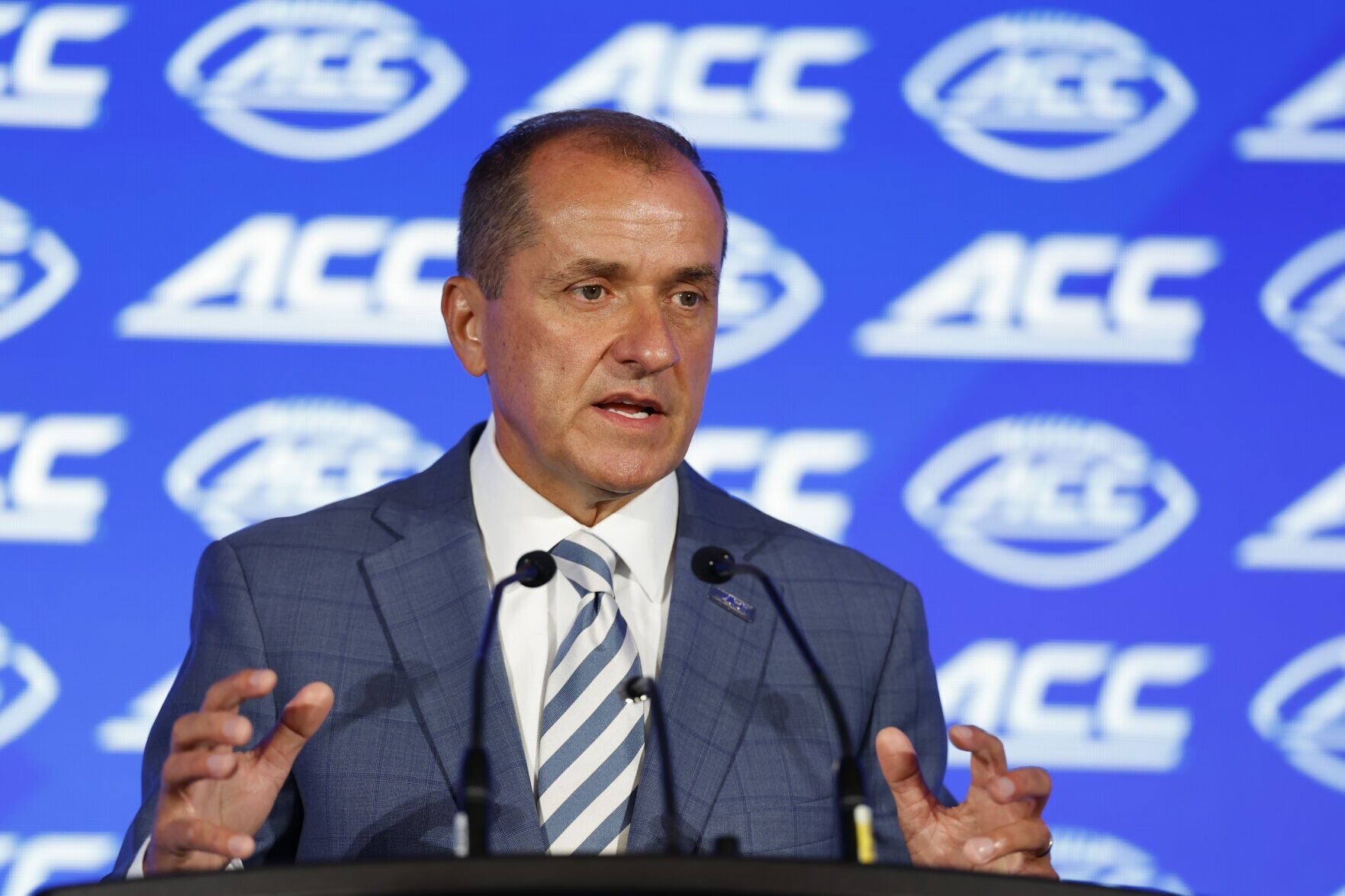
ACC commissioner Jim Phillips speaks during his annual forum to open the ACC football media days on Wednesday in Charlotte, North Carolina.
“Head-to-head matters. That's always most important,” Phillips said. “Then we will look at the grouping and how teams fared in the regular conference season.”
Phillips specifically mentioned that the league is not penalizing teams based on the number of conference games they play. Virginia Tech and UVa are two of the 12 teams playing nine league games. Boston College, Georgia Tech, Florida State, Clemson and North Carolina are playing eight league games.
A team playing nine league games could finish with an 8-1 record. That team would be viewed the same as a team going 8-0 with an eight-game schedule. Ditto for 9-0 versus 8-0.
“Our schedule's not perfect coming up this year because we're going into that transition period where we're going to nine games, we have an uneven number of teams in the conference,” Phillips said. “… Everyone will play 10 Power Four games, so there's some balance there.”
Analytics was the sixth tiebreaker last season. It moves up to the No. 3 slot with SportSource Analytics providing team success rankings for the tied teams. Last season’s analytics would have heavily favored Miami over the other four ACC teams thanks to the Hurricanes’ early win over Notre Dame.
SportSource Analytics is a tool used by the CFP selection committee.
“It will come down to body of work. Who you play, when you play, the games you win, conference and nonconference will matter,” Phillips said. “That's a major change in college sports and certainly for the ACC.”
Expanded CFP
Phillips previously said at the ACC spring meetings that he is in favor of expanding the CFP to 24 teams if the playoff moves from the current 12-team format.
He reiterated that Wednesday and added that he’s “been vocal about the idea that if you have a championship and you have teams that truly could win a championship, and they’re not invited … you don’t have the right format.”
Phillips also continued the talking point of “greater access” to the field. The current 24-team proposal would feature all at-large teams (with at least one Group of Six team included), and the sport’s calendar would have to change to accommodate the extra games.
That also means potentially eliminating the conference championship games (and the tiebreaker policy the ACC just created).
“I do feel like there's good momentum, there's good support. You have to do things in a collaborative way,” Phillips said. “… We're working collaboratively, but there's certainly a lot of momentum about expanding the playoff.”
Protect College Sports Act
Phillips remains firmly in favor of the Protect College Sports Act as federal legislation to potentially stabilize college athletics.
He said he and other league commissioners are “in lockstep” on 90 of the 127 pages of the bill, with the Big Ten and SEC not aligning with the other leagues in specific areas.

ACC commissioner Jim Phillips speaks during his annual forum to open the ACC football media days on Wednesday in Charlotte, North Carolina.
Phillips added he was on a call Tuesday with Senators Ted Cruz (R-Texas) and Maria Cantwell (D-Wash.) as part of ongoing discussions regarding the legislation.
“I remain hopeful. I still remain confident that we can get something done, because if we don't, it's all on us,” Phillips said. “That's our fault. It just is, because we're supposed to be the stewards of this thing called college sports. Whatever that looks like, however long we're in these roles, you want it to look better when you leave than when you first started.”
And what about those talks of the Big Ten and SEC breaking away and forming a super league with its own rules and governance?
“Self-governance, to me, means no governance,” Phillips said.
Eligibility
Phillips endorsed the NCAA Division I Cabinet’s new age-based “five-for-five" eligibility model. It’s a model that gives student-athletes five calendar years to complete five seasons of competition.
The model replaces the previous five-years-to-play-four system that also allowed student-athletes to appeal for additional years of eligibility if one or multiple seasons were lost because of injuries or other unforeseen circumstances.
Phillips submitted an affidavit that supported the NCAA’s case in a lawsuit filed by former UVa quarterback Chandler Morris in the spring. Morris was seeking a seventh year of eligibility.
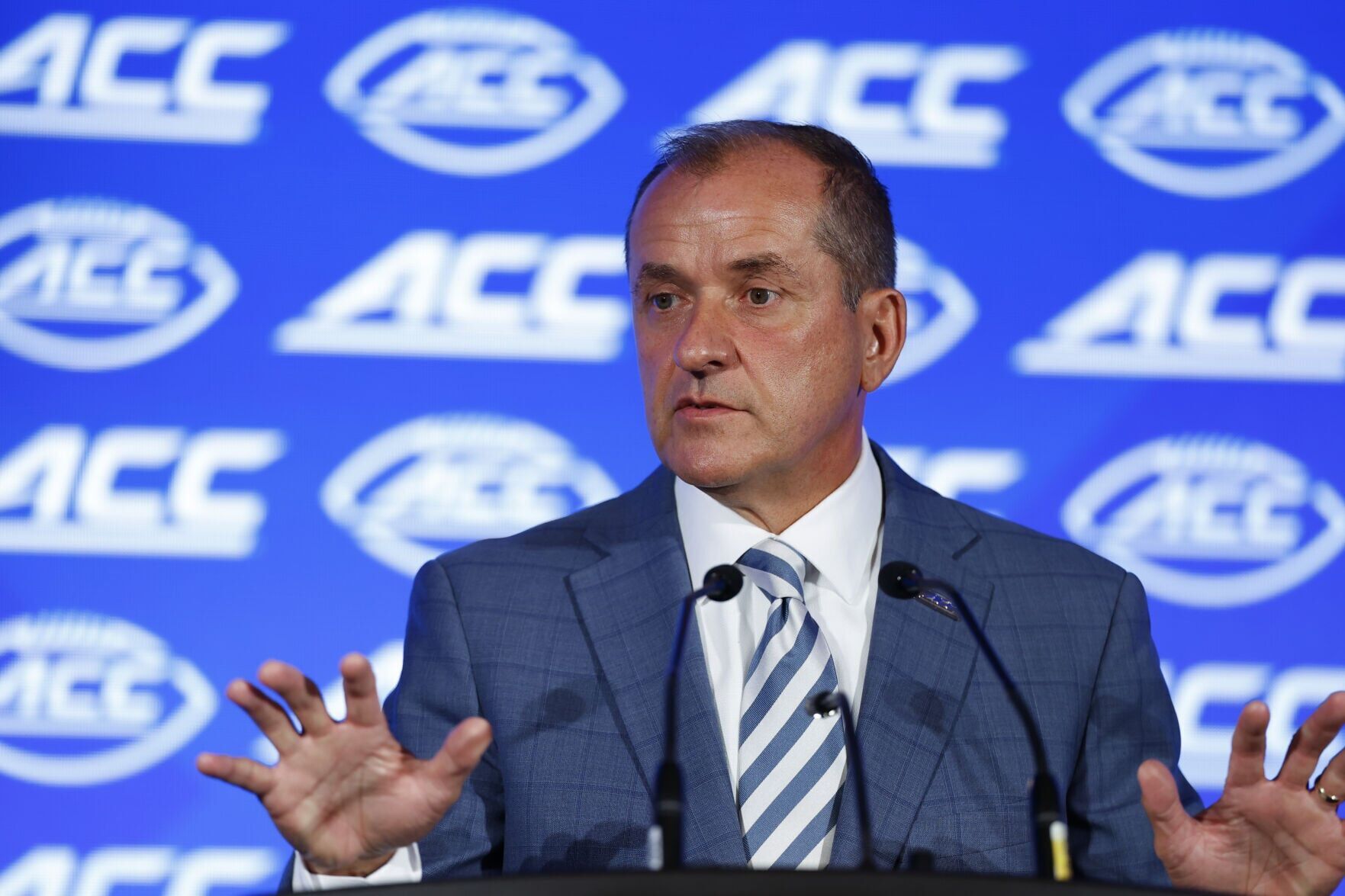
ACC commissioner Jim Phillips speaks during his annual forum to open the ACC football media days on Wednesday in Charlotte, North Carolina.
“I don't blame a student-athlete for wanting to get another year of eligibility no matter what the circumstance is,” Phillips said. “But as it's done in our conference, sometimes you have to go against that. I don't like that. I don't like going against student-athletes, but I did in the springtime with one of our student-athletes because I just didn't feel like another year of eligibility was appropriate.”
Realignment
The Protect College Sports Act would slow down realignment where programs aren’t looking to move whenever television contracts are being discussed.
How does Phillips view realignment with the league featuring 17 football-playing members?
“I’ve always wanted this conference to be a place where schools want to be, not that they have to be,” he said.
Damien Sordelett (540) 981-3124
Related

Explore how college football coaches adapt strategies and tackle challenges to evolve the sport. Dabo Swinney breaks down how he stays motivat…