
Virginia ends year with extra $936 million for state budget
Virginia has nearly $1 billion more to spend in the new two-year budget than expected, as state tax collections rose $350 million higher than the new revenue forecast that Gov. Abigail Spanberger delivered just six weeks ago.
The state ended the fiscal year with $936.3 million more in the bank on June 30 than predicted last fall and $2 billion more than a year ago, as income and sales tax collections continue to surge despite a declining labor force and persistent inflation.
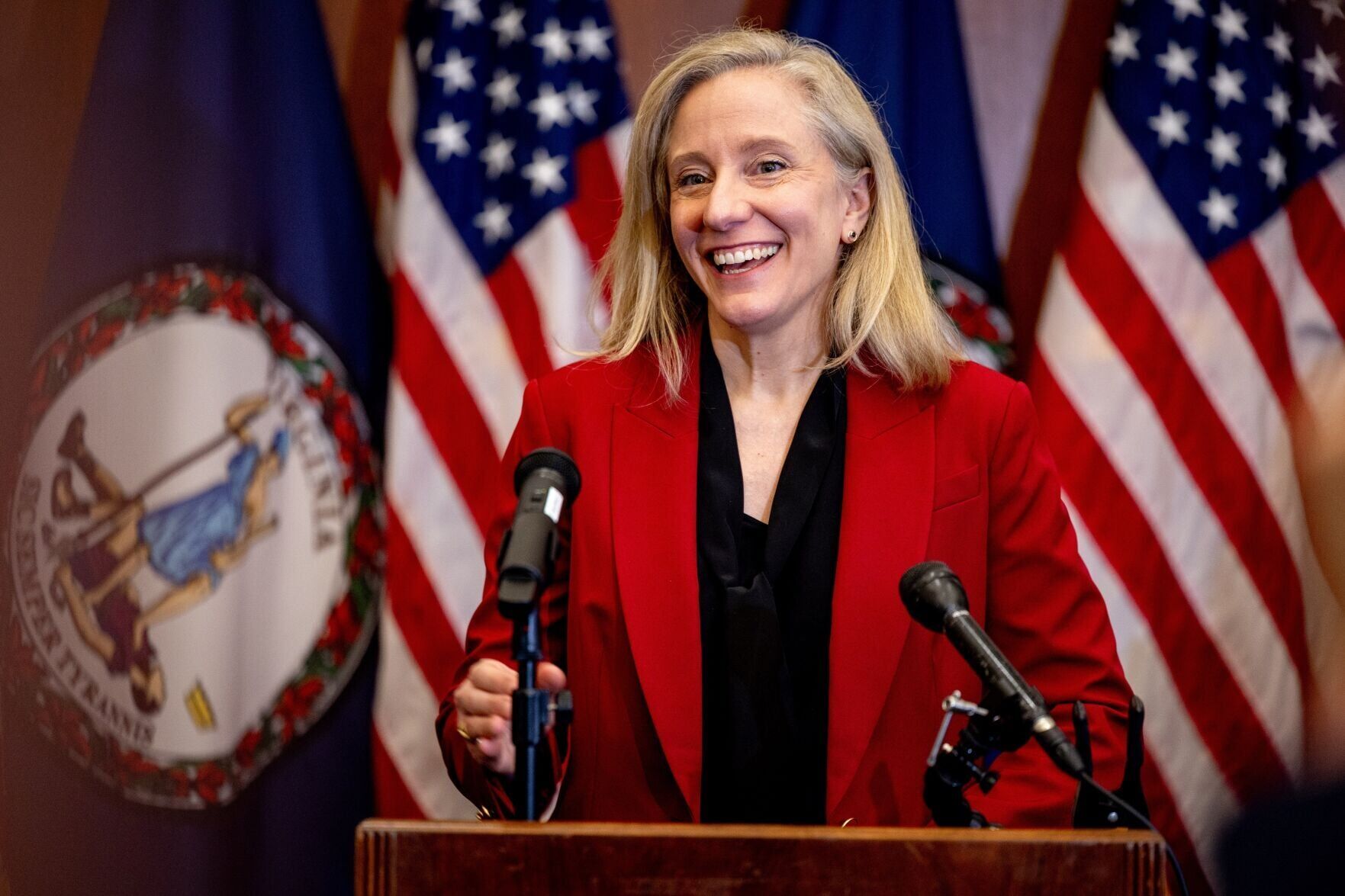
Gov. Abigail Spanberger touted the $936 million budget surplus as evidence of Virginia's "commitment to sound budgeting."
The new two-year budget that took effect on July 1 already assumed $585.5 million in excess revenue in the fiscal year, based on a revised forecast that Spanberger produced for the General Assembly on June 1, but the revenues increased by an additional $350 million primarily because of income taxes from stock market gains and employee payroll collections that further surpassed expectations.
The first-year governor touted the revenue results as evidence of Virginia's "commitment to sound budgeting," despite a sometimes bitter three-month battle among Democratic leaders over how to raise additional money from the data center industry to help the state offset deep cuts in federal support for healthcare and other social safety net programs.
“I am proud of our bipartisan work to produce a balanced budget that delivers on shared priorities," Spanberger said on Tuesday. "Virginia’s adopted budget makes critical investments in education, healthcare, and public safety while setting aside revenue to protect our Commonwealth from the uncertainty coming out of Washington. I look forward to continuing to partner with the General Assembly to provide stability for businesses, families, and communities across Virginia.”
The revenue surplus includes an additional $99.1 million in unexpected revenues in June, primarily from income taxes that investors paid on stock gains, as well as higher taxes withheld from paychecks, which is the state's single largest source of revenue to run the government and provide core public services, such as education, healthcare and public safety.
"The General Assembly and the Spanberger Administration maintained a cautious approach to these volatile revenue sources, which is why they represent such a large share of last year’s surplus," said Secretary of Finance Mark Sickles, a former budget negotiator for the House of Delegates. "We are committed to continuing to exercise caution with respect to these revenue streams to keep Virginia’s balance sheet healthy and resilient amid uncertain national economic conditions.”
Consumer Price Index up 3.5% year-over-year
The national economic outlook remained uncertain on Tuesday. The U.S. Bureau of Labor Statistics reported a 0.4% decline in consumer prices in June, driven by a 10% drop in gasoline prices last month because of the tentative ceasefire and deal to end the war that the United States and Israel launched against Iran on Feb. 28. However, the Consumer Price Index still rose by 3.5% over the previous year, well above the 2% target that the Federal Reserve Board uses to guide its policy on interest rates.
The outlook was clouded by an escalation of hostilities this week between the U.S. and Iran over control of the Strait of Hormuz, a vital shipping lane for oil, fertilizer and other goods from the Persian Gulf region.
However, Virginians have continued to spend on new purchases, despite uncertainty over inflation and jobs, with sales and use tax revenues increasing by almost $22 million last month and $312 million a year ago. Sales tax collections rose by $157.2 million over the forecast that then-Gov. Glenn Youngkin used for the two-year budget he proposed in December.
The big money came from income taxes withheld from paychecks, which grew by $1 billion more than a year ago and exceeded the forecast by $183.4 million. "Significant wage growth sustained withholding revenue despite the Commonwealth experiencing net job losses over the course of Fiscal Year 2026," Sickles wrote in a letter to Spanberger on Monday.
The second-largest gain came from so-called "non-withholding" revenues, which represent income taxes paid by stock market investors and sole proprietors. "Non-withholding revenues are highly correlated with equity prices and thus benefited from stock market growth," Sickles told the governor. "Because the stock market is inherently unpredictable, the FY26 revenue growth forecast called for a cautious 2.2 percent year-over-year increase."
Instead, non-withholding revenues exceeded the forecast by 4.5%, or $347 million, and increased by $510 million compared to a year ago.
Spanberger and Sickles will present a full revenue report to the General Assembly budget committees on Aug. 3.
Michael Martz (804) 649-6964
Related

Virginia House of Delegates wraps up budget session on June 22, 2026.