
Finding 'Project Flash:' How Franklin County residents learned the county was talking to a data center developer
When Rocky Mount resident Laura Carter began filing Virginia Freedom of Information Act requests earlier this year, she wasn't searching for a confidential economic development project.
Carter was trying to understand Franklin County’s proposed zoning ordinance rewrite.
Like many residents following the proposed changes, Carter wanted to know how decisions were made, what discussions occurred before proposals reached the public and how those decisions might shape Franklin County.
One records request led to another.
Meeting minutes led to calendars.
Calendars led to emails.
Emails led to more public records.
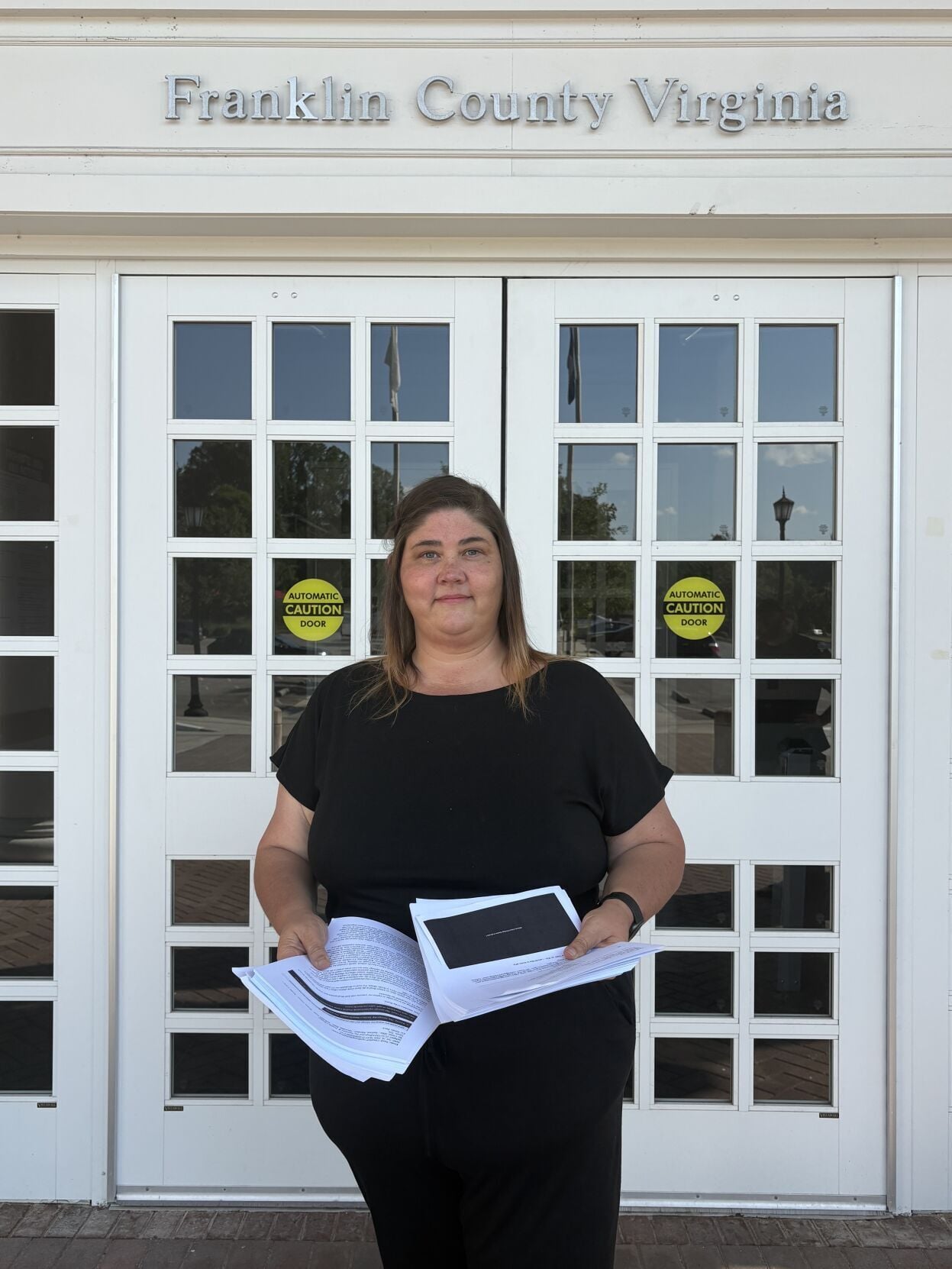
Laura Carter stands outside the Franklin County Government Center in Rocky Mount in July holding close to 500 pages of Freedom of Information Act printouts that detail the county board's communications surrounding Project Flash and Summit View Business Park.
Currently, Carter has filed 11 FOIA requests, seeking calendars, emails, meeting records and other county documents. Carter and fellow resident Penny Hodges personally funded the first round of requests, spending approximately $1,000.
Then, buried inside hundreds of pages of county records, Carter noticed two unfamiliar words: "Project Flash."
This prompted additional FOIA requests for emails and calendar invites.
Soon, the name Crusoe was discovered in association with Project Flash.
Before long, Carter realized she wasn't simply researching a zoning ordinance rewrite. She'd found a second story: ongoing, private discussions between a data center development company and the county government.
As additional records became available, Christine Sizemore, co-founder of the Franklin County Community Coalition (FCCC) became involved, as other members helped dig deeper on Project Flash and Crusoe.
Sizemore said FCCC seeks to keep residents informed about county projects, especially when officials remain silent.
Using two additional FOIA requests funded through community donations and Coalition resources, FCCC expanded the public record surrounding Project Flash while also researching county finances, infrastructure planning and the technical requirements associated with artificial intelligence data centers.
Sizemore’s research reconstructed years of public investment in Summit View Business Park, tracing land acquisition, infrastructure improvements, financing and subsequent borrowing used to prepare the property for future industrial development.
Although the records initially did not center on Project Flash, Sizemore said the investigation soon became closely tied to the possibility of a data center.
“The biggest thing is really this push for transparency,” she said. “Citizens should not have to do this level of research to get information about projects funded with taxpayer money.”
Rather than focusing solely on whether a data center eventually comes to Franklin County, Sizemore said her concerns center on how major public decisions are made, how much information citizens receive before those decisions are finalized and whether residents have meaningful opportunities to participate in the process.
As Carter, Sizemore, FCCC, and residents continued gathering records, the investigation gradually spread beyond public documents.
Neighbors compared notes and shared documents.
Questions surfaced at Franklin County Board of Supervisors meetings.
Discussions that had once been confined to calendars and emails moved into restaurants, cafes, churches and front porches throughout the county.
For residents living near Summit View, the questions became personal.
Daniel Cundiff, is one such resident.
“When I go to Summit View to walk my dog, I see families having birthday parties under the pavilion or church groups having Sunday lunches,” he said. “I hear children playing from the local neighborhoods and from the playground next to the church. The innocent laughter and playful sounds of joy and our future may not exist with a loud data center’s constant noise, not to mention the possible environmental impacts.”
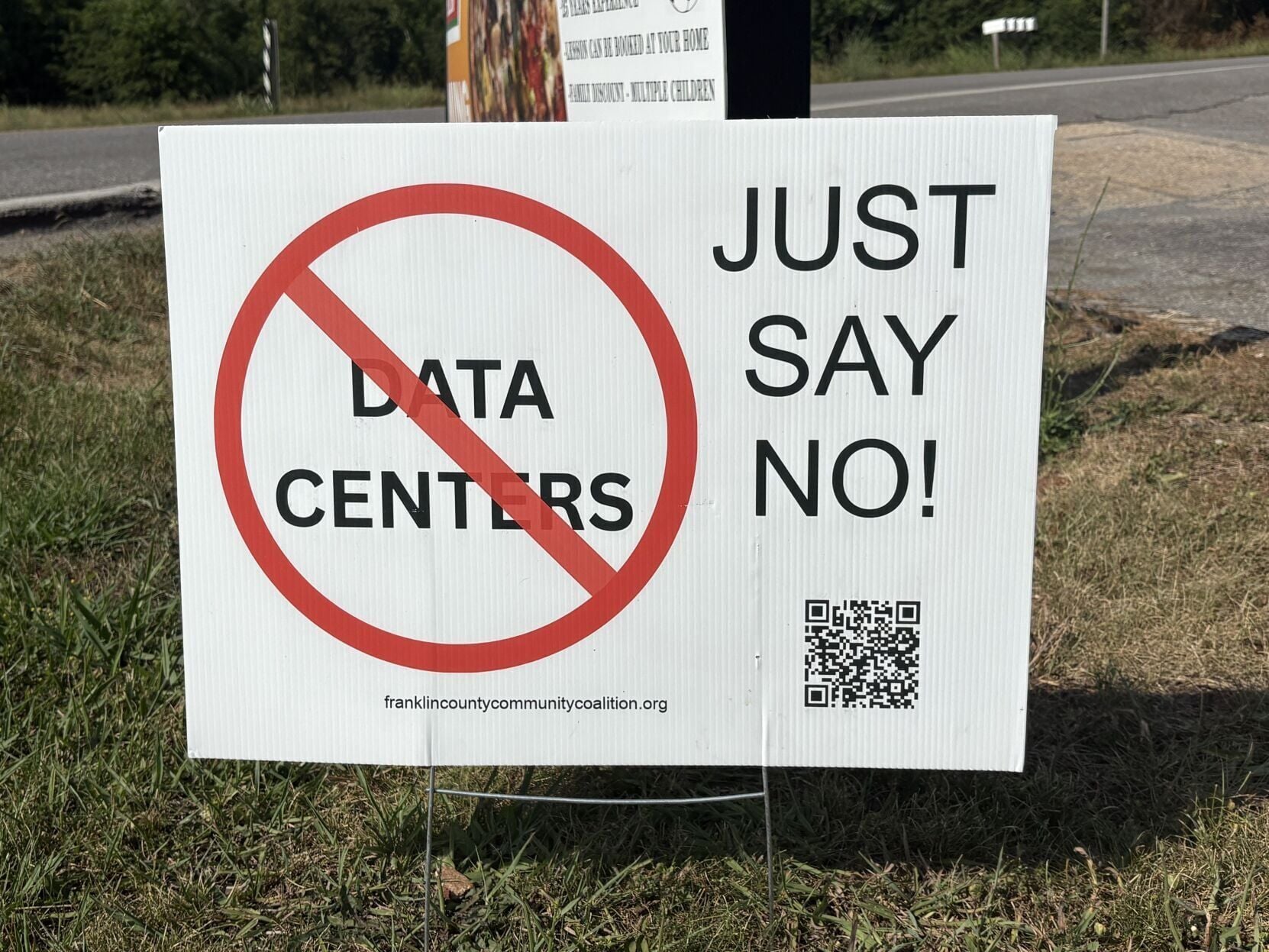
In response to questions, rumors and Freedom of Information Act documents about a supposed data center in Frankin County, signs such as these have been popping up along roadways and in front yards in the county.
The questions raised by Project Flash were no longer limited to one proposed economic development project. They expanded into how Franklin County government conducts the public’s business.
For Rebecca Saunders, those questions centered on how county decisions were made.
Saunders became involved through Friends of Ferrum Park, where volunteers had spent years raising funds to build a public park. After the group’s request for county assistance with a utility extension was denied, another recreation proposal — the Westlake dog park — received county funding.
It was the records surrounding that decision, however, that captured Saunders’ attention.
Documents obtained through the FOIA showed that following the Franklin County Board of Supervisors’ May 4 work session, board Chair Lorie Smith emailed supervisors individually asking whether they supported including funds to support Ferrum Park. Supervisors responded individually by email, and Saunders said she could find no subsequent public vote denying the expenditure.
“We were shocked!” Saunders said. “How is that even legal?!”
During a later town hall, residents asked Smith about a proposed data center. She refused to answer the questions.
Following the meeting, Hodges spoke with Director of Planning Lisa Cooper after written questions she submitted were not addressed. According to Hodges, she was told the questions could not be located.
“I handed in questions,” she said. “Lisa told me they were lost, misplaced or destroyed.”
That conversation was witnessed and corroborated by county resident and FCCC co-founder Kim Jones.
“That’s exactly what she (Cooper) said,” Jones related.
An email later obtained through the FOIA added to her concerns. Writing to Supervisor Marshall Jamison on April 13, one day before a public hearing connected to the proposed zoning ordinance, Smith wrote: “I am expecting a crowd, hope I am wrong.”
In the same email, Smith wrote she had “still heard nothing regarding Project Flash,” while noting Appalachian Power Co. and the unnamed company were “supposedly in negotiations.”
Months later, the board revised its public comment procedures, eliminating the five-minute slot previously available to citizen groups, reducing it to the usual three minutes. Supporters said the change would allow more individuals opportunities to address the Board.
“I want to hear from each citizen, and I don’t care how long I have to sit here,” Smith said.
Critics argued it reduced opportunities for organized groups to present detailed concerns and also pointed out a conflict with Smith’s earlier comment about hoping people would not attend the meeting.
Sizemore said concerns about public participation were among the reasons residents organized the FCCC.
“There’s always a fear of retaliation,” Sizemore said. “Plus, some fear for their jobs, and some don’t like to speak publicly. Having an organization under whose umbrella you can operate…rather than just a single person operating on their own. And now, with the recent board changes, they aren’t gonna allow spokespeople to make broader comments.”
Former Franklin County School Board member Jon Atchue believes concerns about transparency predate Project Flash. Recalling a 2020 conversation following a school board meeting, Atchue said Smith privately warned him that a teacher’s public comments involving a company considering Summit View could jeopardize cooperation between the School Board and the Board of Supervisors, even though the teacher was there as a citizen not an educator.
“I viewed that as a threat,” Atchue said.
Smith did not respond to an email asking about the exchange.
“You know what? That is so par for the course,” Sizemore said.
Carter said she hopes readers will ultimately do what she did — read the records and decide for themselves.
“I don't want anyone to simply believe me,” Carter said. “I want them to look at the records, attend the meetings, ask questions and reach their own conclusions.”
She also said she hopes residents will fill the Government Complex in Rocky Mount for the next Board meeting, scheduled for 6 p.m. July 21
“We need people to show up,” she said.
David Campbell is a freelance journalist and educator based in Ferrum. Contact him via Brian Kelley at brian.kelley@roanoke.com, 540-981-3377.
Related

What to know about data centers, produced with AI-assisted narration.