
Virginia voters to decide whether to enshrine reproductive rights in state Constitution

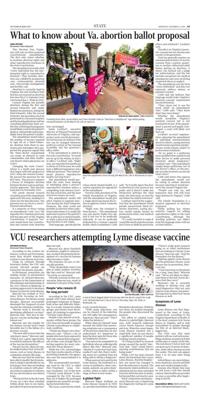
Traveling from Ohio, Sarah Kolich and Clare Strahler hold an “Abortion Is Healthcare” sign while joining counterprotesters at the March for Life on April 22.

Abortion opponents chant during the March for Life in Richmond on April 22.

Jamie Lockhart, executive director of Planned Parenthood Advocates of Virginia, is seen in 2024. She said said supporters want constitutional protection because an ordinary state law can be changed whenever political control of the General Assembly and the governor’s office shifts.

Victoria Cobb, president of The Family Foundation of Virginia, is seen in 2024. Cobb said voters who oppose the amendment would not be voting to outlaw abortion because rejecting it would preserve the current Virginia law.
This Election Day, Virginians will vote on three proposed constitutional amendments. The first asks voters whether to enshrine abortion rights and other reproductive freedoms in the state Constitution.
The amendment provides that “every individual has the fundamental right to reproductive freedom.” That includes abortion care, childbirth, postpartum care, contraception, prenatal care, miscarriage management and fertility care.
Abortion is currently legal in Virginia; the only Southern state that has not enacted an abortion ban since the U.S. Supreme Court overturned Roe v. Wade in 2022.
Current Virginia law permits abortions during the first and second trimesters and, under limited circumstances, during the third trimester. After the second trimester, the procedure must be performed in a licensed hospital, and the treating physician and two consulting physicians must certify that continuing the pregnancy would likely result in the patient’s death or substantially and irremediably harm the patient’s health.
The amendment would reduce the number of doctors required to sign off on a third-trimester abortion from three to one. Democratic lawmakers who supported the proposal argued that the three-doctor requirement can create an obstacle in rural communities and other healthcare deserts where physicians are scarce.
Changing the state Constitution is a multi-year process that began with this proposal in 2025, when the General Assembly first passed the measure. The process requires a House of Delegates election between the first and second legislative approvals. That election took place in November 2025.
The newly elected General Assembly passed the amendment again early this year, sending it to voters for the final decision. The governor has no role in a constitutional amendment.
If a majority of those voting on Amendment 1 vote “yes,” the reproductive-freedom provision will become part of the Virginia Constitution. A majority “no” vote would leave the Constitution and current state abortion laws unchanged.
Jamie Lockhart, executive director of Planned Parenthood Advocates of Virginia, said supporters want constitutional protection because an ordinary state law can be changed whenever political control of the General Assembly and the governor’s office shifts.
If the amendment is added to the state Constitution, “it would not be up to the whims of who's in office,” Lockhart said. “Right now, our reproductive healthcare is always at risk because we could have a different legislature and a different governor. This (amendment) protects reproductive healthcare long term.”
The amendment would prohibit the state from denying or infringing upon a person’s reproductive freedom unless a compelling state interest justifies the restriction and the least restrictive means are used.
The amendment would still allow Virginia to regulate abortion during the third trimester. However, the state could not prohibit an abortion when a physician determines it is medically indicated to protect the patient’s life or physical or mental health, or when a physician determines that the fetus is not viable.
That language, specifically the clause about mental health, is a central argument for opponents of the amendment.
Victoria Cobb, president of The Family Foundation of Virginia, said the amendment would give a single physician broad discretion to approve a third-trimester abortion.
“Right now, the standard is three doctors … This amendment says one doctor makes the call, and it just has to be medically indicated. It can be medically indicated for a woman's mental health, which is undefined,” Cobb said. “So it really opens the door to abortion for any reason at any point, and it doesn't make any distinction between the 32nd week, the 36th week, or even the day before the child is to be born.”
Lockhart rejected the suggestion that the amendment would permit unrestricted third-trimester abortions, saying doctors would remain bound by professional ethics and medical standards.
“It’s really harmful to make it sound like medical professionals don’t have to abide by particular ethics and standards,” Lockhart said.
The effect on Virginia’s parental-consent law has also become a point of disagreement.
State law generally requires an unemancipated minor to receive consent from a parent, guardian or another authorized adult before getting an abortion. A minor can instead ask a judge for authorization, and the law includes exceptions for medical emergencies and cases involving suspected abuse or neglect.
The amendment uses the term “every individual” and does not expressly address minors or parental consent.
Cobb said she believes that language would make Virginia’s parental-consent requirement unconstitutional.
“They chose not to use the word ‘adult’ on Amendment One,” Cobb said. “They knew what they were doing.”
Whether the amendment would invalidate Virginia's parental consent law is not resolved by its text. If the amendment is passed and legally challenged, a court will likely sort that out.
Lockhart accused organizations opposing the amendment of spreading misinformation about its effects, saying abortion would remain regulated and physicians would remain subject to professional standards.
“At no point is a politician more qualified than a patient and their doctor to make personal decisions about pregnancy,” Lockhart said. “This amendment simply keeps politicians out of the doctor’s office, so the people actually involved can decide what’s best.”
Cobb said voters who oppose the amendment would not be voting to outlaw abortion because rejecting it would preserve the current Virginia law.
“People can vote no, and tomorrow they will still have legal abortion in Virginia,” Cobb said.
The Family Foundation is a staunch opponent of abortion in general.
Public polling has shown majority support for adding reproductive rights to the state Constitution, although the wording pollsters use differs from the language voters will see on their ballots.
A January 2026 survey from Christopher Newport University’s Wason Center found that 66% of registered Virginia voters supported or strongly supported amending the Constitution to guarantee reproductive rights, including access to abortion and contraception. The survey included 807 registered voters and had a margin of error of plus or minus 4.4 percentage points.
A 2025 VCU Wilder School poll found that 62% of Virginians supported including abortion rights in the state Constitution.
Anna Bryson (804) 649-6922
Related

Maymont’s Bier-Garden returns; Virginia Wine Month; Top Five