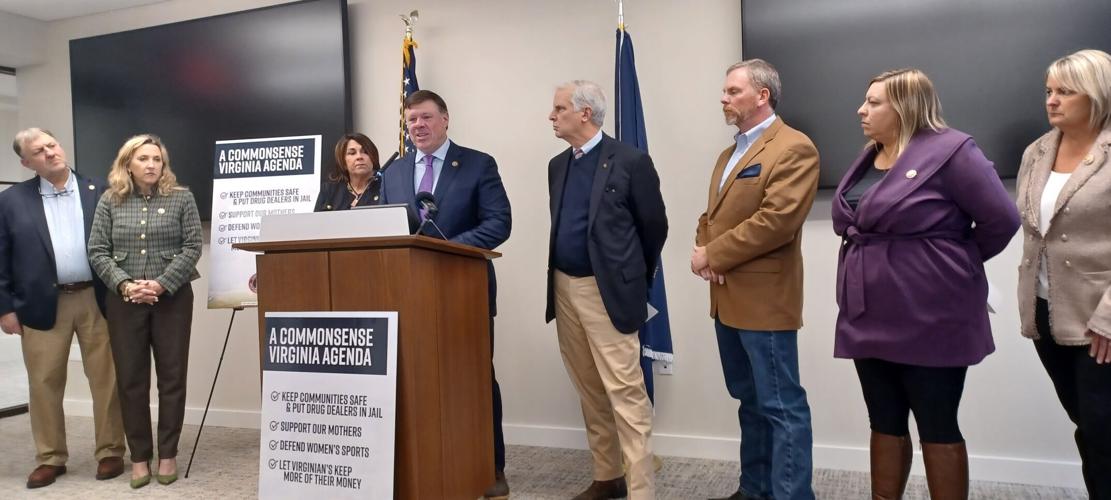

Republican state senators plan to push for more time in prison when repeat offenders use guns when committing violent felonies.

Senate Minority Leader Ryan McDougle, R-Hanover, at podium, outlines GOP priorities for the 2025 General Assembly session.
People are also reading…
RVA 100: 100 people, places, things that you should know about Richmond
The RVA 100 are the people, places, things that make Richmond so special. The Times-Dispatch will be highlighting 100 quintessential Richmond icons starting Aug. 1 and running throughout the year.
Submit your ideas for what and who we should feature at go.richmond.com/rva100yourturn.

Head south from downtown Richmond on Interstate 95 and, yes, that big concrete office building does look like a pack of cigarettes with a few butts sticking out.

Richmond’s more than 100 murals range from thought-provoking to statement-making to just plain odd.

No, that’s not a flying saucer that landed just west of Willow Lawn shopping center. It’s the Markel Building, commissioned in 1962 by the specialty insurer Markel and designed by Richmond architect Haigh Jamgochian.

One of Richmond’s most popular and picturesque spots is Maymont, a Victorian estate set on 100 rolling acres above the James River. Maymont serves as a park, museum, environmental center and more.

Born July 15, 1864, in Richmond, Maggie Lena Walker rose to prominence as a businesswoman and community leader. The first African American woman in the United States to found a bank, Walker provided economic empowerment to women and strengthened Richmond’s emerging Black middle class.

Libby Hill Park is one of three original parks in Richmond, located in Church Hill. The seven-acre park was designed by city engineer Wilfred Cutshaw.

Established in 1993, the Richmond Kickers are the longest continuously run professional soccer club in the country and a cornerstone of RVA’s sports scene.

Before racking up nine All-Star selections, a Rookie of the Year award, three Cy Youngs, two World Series rings, two ERA titles and an MVP, Justin Verlander pitched for Goochland High School.

The historic Jefferson Hotel has welcomed thousands of visitors in its nearly 130 years of operations, including the likes of U.S. presidents, writers and celebrities such as the Rolling Stones, Dolly Parton and Elvis Presley.

At Richmond, Virginia’s backbone waterway passes its final falls and rapids to begin its more stately path to the Chesapeake Bay. You can spot bald eagles and ospreys circling overhead; herons stalk the shore.

For those who want to understand the complex history of Richmond, Jackson Ward is ground zero.

Nestled alongside the rapids of the James River, Hollywood Cemetery is host to the graves of many noteworthy Virginians.

Chimborazo Park is laden with city history and lore while also letting park-goers experience all of Richmond.

When in search of a fun day of shopping, dining and entertainment, Carytown is the hub for indie boutiques, flavorful food spots and more to satisfy a local’s or visitor’s experience.

Professional baseball was played for generations in Richmond before the Flying Squirrels soared into town for the 2010 season. Nothing before was comparable in name, entertainment presentation, or impact.

The 26-story building that houses the Federal Reserve Bank of Richmond has towered over the James River and dominated the city’s skyline since 1978.

This story is part of RVA100, our series that highlights the people, places and objects that define the Richmond region. We’re exploring hidden histories and colorful backstories.

This story is part of RVA100, our series that highlights the people, places and objects that define the Richmond region. We’re exploring hidden histories and colorful backstories.

For nearly 50 years, the Richmond Coliseum stood as the city’s premier venue for sports, concerts and political rallies.

This story is part of RVA100, our series that highlights the people, places and objects that define the Richmond region. We’re exploring hidden histories and colorful backstories.

This story is part of RVA100, our series that highlights the people, places and objects that define the Richmond region. We’re exploring hidden histories and colorful backstories.

For those new to Richmond, the Virginia War Memorial Carillon rises like a distant beacon above its leafy Byrd Park neighborhood.

This story is part of RVA100, our series that highlights the people, places and objects that define the Richmond region. We’re exploring hidden histories and colorful backstories.

This story is part of RVA100, our series that highlights the people, places and objects that define the Richmond region. We’re exploring hidden histories and colorful backstories.

This story is part of RVA100, our series that highlights the people, places and objects that define the Richmond region. We’re exploring hidden histories and colorful backstories.

This story is part of RVA100, our series that highlights the people, places and objects that define the Richmond region. We’re exploring hidden histories and colorful backstories.

This story is part of RVA100, our series that highlights the people, places and objects that define the Richmond region. We’re exploring hidden histories and colorful backstories.

Starting today, we're launching our RVA 100 series, which highlights the people, places and objects that define the Richmond region. For 100 days, we’ll showcase a different quintessential Richmond icon. First up: Agecroft Hall.

On the south bank of the James River off Riverside Drive and across from Williams Island, Pony Pasture is among the most popular spots in the James River Park System.

With most of its structure built in the early 1880s, Pump House has ceased to host the elaborate dance parties in its ballroom that the granite Victorian Gothic structure was once known for early in its 140-year history.

Richmond Ballet was founded in 1957 by a group of ambitious student dancers.

As the largest performing arts organization in central Virginia, the Richmond Symphony is a harmonious hub that provides a musical treat to viewers and listeners, whether it be through concerts, radio broadcasts or educational outreach programs.

Since its inception in 1979, the Richmond area’s top high school football honor of All-Metro Player of the Year has just two repeat winners — Highland Springs quarterback Khristian Martin (2022, 2023) and Collegiate QB Russell Wilson (2005, 2006).

With stacked hot pastrami, spicy brown mustard, a grilled split knockwurst and melted, gooey Swiss cheese all packed between two toasted, buttery rye slices, the sailor sandwich has been a fan favorite for generations.

A Richmond icon, Sally Bell’s Kitchen turns 100 years old this year.

Train service at Richmond's Broad Street Station peaked during World War II, when a record 33,324 passengers came and went in one day in 1943.

Parker Field was old and quickly deteriorating. Richmond-area baseball fans noticed. So did the Atlanta Braves, who owned the Triple-A team that played there. Richmond was at risk of losing its minor league franchise if it did not act rapidly.

Richmond is old. And few landmarks speak to the city’s storied history like the Virginia Capitol building.

Beginning as 600 acres of land inherited by U.S. Army Gen. Winfield Scott in 1818, the historic district that became known as Scott’s Addition saw residential growth in the late 19th century before developing into a major industrial district during the late 1920s through 1950s.

Virginia Commonwealth University’s two campuses have grown tremendously through the years, changing the face of downtown. VCU is credited for restoring neglected portions of the city, but critics say it has erased some of Richmond’s charm.

On the 52-mile-long Virginia Capital Trail, more than 1 million annual visitors tour 400-plus years of history from Richmond to Jamestown.

A star football player from Richmond’s Maggie L. Walker High School and Baltimore’s Morgan State University, Willie Lanier is famously the first African American to professionally play middle linebacker. He was a part of the Kansas City Chiefs’ Super Bowl IV championship team in 1970 and is a member of the Pro Football Hall of Fame (Class of 1986).

The Blues Armory, both as a building and cultural institution, awaits a new chapter in its long and varied history. Built in 1910 for the Richmond Light Infantry Blues, the historic building is part of an impending plan for redeveloping the center of downtown Richmond.

Bill "Bojangles" Robinson is dancing in the aluminum statue that stands in Jackson Ward, the majority Black neighborhood where he grew up in racially segregated Richmond. But Robinson, a trailblazer as a Black entertainer in early 20th-Century America, didn't forget his home town or the challenges facing Black students there.
That's why the Astoria Beneficial Club led the effort to honor him with the statue dedicated on June 30, 1973, almost a quarter-century after his death in 1949.

Before Pabst Blue Ribbon became the unofficial “People’s Beer of Richmond,” there was Krueger’s Finest.

While the University of Virginia has the Rotunda and William & Mary has the Wren Building, the Medical College of Virginia has the Egyptian Building.

There is nothing quite as dark and mysterious as the lore that surrounds famed poet and storyteller, Edgar Allan Poe.

Among the reminders that Richmond is nearly 300 years old: those cobblestone and Belgian block streets that can wreak havoc on the underside of modern motor vehicles.

Born free in 1866 to a formerly enslaved couple in Cumberland County, Fannie Criss Payne was one of the first Black fashion designers in the country.

The Triple Crossing is one of the country’s most distinctive railroad attractions, as three railroad lines cross at different levels at the same spot.

Tredegar Iron Works was established in 1837 as an iron forge and rolling mill located along the Kanawha Canal and James River.

The Richmond Dairy Co. building is a byproduct of the advancing technology in the dairy business. The building, which is a Tudor Revival, advertises a brief time in American history during which we were delivered fresh milk daily, before the rise of in-home refrigeration and after the advent of glass bottles.

Sixth Mount Zion Baptist Church has stood as a place of faith and fellowship for more than 150 years in Richmond.

The Richmond Union Passenger Railway was the world’s first electric railway, dating from 1888 to 1949.

One of music’s greatest pioneers of the 20th century, Sister Rosetta Tharpe bridged the gap between gospel and secular music by incorporating rock, jazz and R&B sounds into her songs.

Henry “Box” Brown pulled off one of the great escapes from slavery when he shipped himself in a box to gain freedom.

Gwar is very loud, a Times-Dispatch article from July 17, 1986 succintly explained.

The clock, more than four feet tall, was installed in the 1920s and stayed there more than 60 years.

There's just one monument left on the famed Monument Avenue, the bronze statue of local tennis legend Arthur Ashe.

Petersburg legend Moses Malone is famous for being the first player to successfully make the jump straight from high school to professional basketball after signing with Utah of the American Basketball Association.

Founded by free and enslaved Black people in 1857, Ebenezer Baptist Church — originally and briefly Third African Church — served as a beacon of education and recreation at Judah and West Leigh streets in historic Jackson Ward.

Virginia’s Executive Mansion, home to the state’s governors since 1813, has entertained many distinguished visitors — from current and future presidents to the Marquis de Lafayette, Winston Churchill, Rosa Parks, Arthur Ashe and Queen Elizabeth.

As a child, when the Legendary Santa called you by name, that memory was priceless.

Vince Gilligan, 57, creator of the AMC hit show ‘Breaking Bad,’ has Richmond roots.

Tucked away in downtown Richmond, the Pipeline Trail is possibly one of the city’s best-kept secrets.

Pat Benatar, the iconic 1980s singer known for hits such as “Hit Me With Your Best Shot,” first began her musical career in the River City.

Ellen Glasgow had always wanted to be an author.

He played baseball in the Negro Leagues beginning in 1933 and was one of countless Black players denied the chance to play in the major leagues.

Pocahontas has been elevated to a household name by colonial legends and a more recent Disney adaptation that tells her story.

It may not be a physical icon for much longer since local developer Hourigan Group has said it plans to raze the Southern States silos and build a mixed-use project on the old grain elevator’s site on the south bank of the James River.

For nearly eight decades, the site of Richmond Raceway has been home to many kinds of horsepower.

The Richmond Times-Dispatch traces its beginnings to 1850 with the founding of the Richmond Dispatch by James A. Cowardin. In 1886, Major Lewis Ginter founded a rival paper, The Daily Times, which in 1887 he gave to his friend and attorney Joseph Bryan, beginning the paper’s long association with the Bryan family. In 1890, Bryan changed the newspaper’s name to the Richmond Times.

One of Richmond’s most colorful personalities, Donnie Corker was a legend in Richmond’s counterculture.

Richmond’s Museum District is known for its historic charm and picturesque streets lined with well-preserved early 20th-century homes and cozy cafes. Hence its namesake, the neighborhood’s East border is lined with a continuous six-block stretch of museums on the west side of Arthur Ashe Boulevard, including the Virginia Museum of Fine Arts, one of the largest comprehensive art museums in the U.S.

The 26-story building that houses the Federal Reserve Bank of Richmond has towered over the James River and dominated the city’s skyline since 1978.